
IT Equipment Depreciation Calculator and IT Disposal Planner
IT Equipment Depreciation Calculator from ITAMG projects book value for business hardware using the finance assumptions you supply. ITAMG's online planner also compares quoted recovery and disposal costs for laptops, desktop computers, servers, storage and networking equipment. Check release readiness and compare disposal dates with the evidence you have.
Start with the online calculator below, or complete the download form to get the Excel calculator, worked example and PDF guide. Book values are optional when requesting an IT equipment disposal quote.
- Certified: R2v3
- Certified: NAID AAA
- Certified: RIOS
IT Asset Management Group (ITAMG)
Calculate book value and plan IT equipment disposal
Quick book value projects straight-line depreciation for business IT hardware. Check IT retirement readiness identifies unresolved ownership, service, reuse, approval and data-handling facts. Plan an IT disposal project combines equipment groups, finance records, quotes, costs and later-date scenarios.
Calculations and imported CSV files stay in your browser. The calculator does not send these inputs to ITAMG. How your data is used · Input and result guide · How the calculation works
Enter IT equipment groups manually or import a CSV, then add the finance records, quotes and costs you have. Calculate the plan and review any missing evidence. This page does not save your work after you close or reload it.
Add an IT equipment group or load the invented laptop example, then calculate. Review projected book value, cash after deductions, quantities covered and any missing evidence.
The IT equipment calculator processes inputs in your browser. It does not submit your inventory, finance records, quotes or costs. Download requests and project inquiries use separate forms. How your data is used
Using the IT equipment planner and your data
The online IT equipment planner calculates from the facts you enter or import. Use this guide to interpret the inputs, understand what is submitted through each form and clear your work.
Input and result guide
- Equipment groups and planned units
- A cohort is a group of IT equipment with matching assumptions. Inventory quantity is the full group; planned quantity is the portion proposed for this project. A finance allocation applies to the full group before the planned portion is calculated.
- Planned outcome
- Planned outcome means what happens to an IT equipment group: resale, internal reuse, recycling, donation or lease return. Different groups may have different outcomes. Later-date cash comparisons require a separate plan containing only the resale and recycling groups. Keep Undecided selected until the intended outcome is confirmed.
- Currency and months
- All amounts use the displayed project currency. Currency changes do not convert values. Depreciation counts whole anniversary months; explicit holding months set the cash horizon separately.
- Lot total and per unit
- A lot total covers exactly the units listed in the selected quote. Check Amount is per unit only for a unit price. Select one quote or estimate per cohort.
- Unknown, zero and coverage
- Unknown means evidence is missing; confirmed zero requires an explicit 0. Partial means only the stated units or costs are covered. A known subtotal is not complete project cash. Read exceptions before using any result.
- Book, settlement and gain
- Book is the carrying amount or planning projection. Settlement is cash after quote deductions. Gain or loss uses only matching resale/recycling units and approved direct disposal costs. Period cash costs stay outside that disposal line.
- Editable inputs and calculated results
- Fields accept your inputs. Results are labeled and read-only. Material changes mark results out of date until you calculate again. Errors identify the item and keep your entered values.
Calculating and importing CSV
The calculator reads CSV files and calculates IT equipment book values, quote comparisons, project costs, scenarios and readiness results in your browser. It does not send those calculation inputs to ITAMG. The site and its project inquiry form have separate data practices described in the ITAMG Privacy Policy.
The planner supports up to 1,000 equipment groups, 1,000 finance records, 1,000 costs and 10 scenarios, with one selected quote per equipment group. CSV import previews the columns before you apply them. Invalid rows stop the import and identify what to correct.
Clearing your online plan
Clear fields resets Quick book value inputs and results. Clear answers resets the IT retirement readiness check. Clear plan removes the project inputs and results from this page. Closing or reloading the page also clears the online plan.
Clearing the calculator does not remove contact details already submitted through a download or project inquiry form. Use the ITAMG Privacy Policy for information about those records.
Working in Excel
To keep and share an IT equipment plan, complete the Excel download form and enter your project in the workbook. The online calculator does not export a plan or transfer it into Excel.
The workbook has no built-in submission feature. Excel and your storage settings control saving and syncing, including OneDrive, SharePoint and shared folders. Sharing a whole workbook includes its sheets and notes. Formula protection is not encryption.
Download requests and project inquiries
Complete the download form on the Excel download page to access the blank workbook, worked example and PDF guide. ITAMG receives the first name, last name, company name, email and phone number you submit. Calculator inputs are not included.
The project inquiry form uses ITAMG's standard contact process. Your calculator inventory and financial inputs are not attached automatically. Business inquiries continue to ITAMG's thank-you page, where you can book a meeting. See the ITAMG Privacy Policy for information about submitted details.
How to calculate IT equipment depreciation
IT equipment book depreciation allocates capitalized cost, less residual value, over the useful life set by finance. ITAMG's planner applies a stated whole-month convention and keeps the resulting book projection separate from quoted proceeds and project cash.
IT equipment book value, resale proceeds and net cash
IT equipment book value, resale proceeds and net cash answer different questions. Compare figures for the same hardware, quantity and date, using the evidence required for each.
| Figure | Question it answers | Evidence the planner asks for |
|---|---|---|
| Book value | What carrying amount does finance hold or project at a date? | An approved register balance, or your own straight-line policy: cost, residual, life and start date. |
| Estimated proceeds | What might a buyer pay under stated conditions? | A dated quote, or an estimate you label as your own. Never a curve inferred from depreciation. |
| Net cash recovery | What cash remains after settlement terms and project charges? | Gross or net quote basis, any revenue share, deductions and project cash costs, each counted once. |
| Tax treatment | What cost recovery applies for tax? | Outside this planner. Tax depreciation depends on jurisdiction, elections and entity facts. |
Straight-line depreciation for IT equipment
Straight-line IT equipment depreciation spreads capitalized cost, less residual value, evenly over the useful life you supply. The planner applies the monthly charge to completed months and stops at residual value. A blank cost remains missing.
Monthly depreciation per unit = (capitalized cost − residual value) ÷ useful life in months.
Projected book value per unit = the greater of residual value and capitalized cost minus monthly depreciation × completed months.
The cost-based formula applies to an owned-equipment projection with valid inputs. The planner counts whole anniversary months and stops the projection at residual. Approved opening balances and dated posted balances follow the separate rules below.
Months are counted as whole anniversary months: a month counts once the same day of the month has passed. Equipment placed in service on the 15th and valued on the 14th of a later month has one fewer month than one valued on the 15th. This is a stated planning convention that the workbook shares. It is not a universal accounting rule, and your finance team's period convention governs the posted figures.
When finance already holds an approved balance, the planner uses it as an opening carrying amount and projects only forward over the approved remaining life. It does not reconstruct historical depreciation. A posted balance with no remaining life is shown as imported and is never rolled forward. Book projections require confirmed owned equipment. Several cohorts can share one finance record by positive allocation, and the parent balance is counted once. Planned quantity is an explicit choice: blank remains unknown and 0 means none are proposed.
Estimate net cash recovery from your quote evidence
Net cash recovery starts with a dated quote, your own labeled estimate, or a confirmed zero. Missing evidence leaves units uncovered, and totals show the planned quantities they cover. An expired quote is excluded from confirmed recovery until it is renewed. Review coverage before treating a subtotal as the project result.
For a gross quote, enter the applicable deductions. For a net quote, use the stated settlement amount and identify charges already included. Under a revenue share, the planner subtracts pre-split deductions, applies the seller's share, and subtracts post-split deductions. Additional project cash costs reduce settlement cash; internal effort stays on a separate non-cash line. Negative net recovery remains visible.
For the market assessment behind a quote, see how used computer equipment is valued. For deduction structures, see IT equipment buyback pricing models.
Compare retiring IT equipment now or later
The retirement comparison shows the cash difference between releasing equipment now and releasing it on a later date. It projects book value at the later date, uses the future proceeds you enter, and subtracts future charges and cash holding costs. The comparison applies to equipment that can be released. A blank monthly holding override uses the selected current or custom future cash costs; an explicit 0 replaces those monthly lines. If finance has approved the carrying amount and how charges are treated, it also shows a simplified planning gain or loss and the intervening depreciation, so the cash view and the accounting view can be reconciled rather than confused.
Equipment still in service is a different decision. Keeping it running against replacing it needs equal service, a common horizon, operating and transition costs. The planner labels that case rather than pretending an idle-retirement comparison answers it. No tax, discounting or productive-service value is included anywhere in the results.
Planning limits
- It does not assign a useful life or a resale value from the equipment category. Those are policy and market facts you supply.
- The online planner supports leased IT equipment only under Lease return or Undecided. Ownership and lessor instructions need separate review.
- Book projections are limited to confirmed owned equipment. Other ownership types require finance review; this tool limit does not determine whether an asset is depreciable under your accounting framework.
- Enter up to 1,000 equipment groups, 1,000,000 units per group, 1,000,000,000 currency units per monetary input and 1,200 months per web projection. The online calculator rejects computed amounts or aggregate exposures above 1,000,000,000,000 currency units. Larger projects need a separate finance model.
- It does not turn a depreciation result into a donation tax figure, and it does not model lease accounting.
- Use one currency per IT equipment plan. Changing the currency label does not convert the amounts.
Laptop depreciation example: retire now or in six months
Invented example. Not an ITAMG quote, a market benchmark, a client result or an accounting recommendation. All amounts are USD.
Assume 100 laptops cost USD 1,200 each, with a 48-month straight-line life, zero residual value, and a September 1, 2023 start date. At September 1, 2026, 36 months are complete. The example uses USD 25,000 in gross proceeds and USD 4,000 in disposal cash charges. The six-month alternative assumes USD 22,000 in gross proceeds, the same disposal charges, and USD 500 per month in cash holding costs.
Monthly depreciation is USD 25 per laptop: USD 1,200 divided by 48 months. After 36 completed months, projected book value is USD 300 per laptop, or USD 30,000 for 100 laptops. Six months later, it is USD 150 per laptop, or USD 15,000 for the fleet.
| Line | Retire now | Retire in six months |
|---|---|---|
| Modeled book value at disposal | 30,000 | 15,000 |
| Assumed gross proceeds | 25,000 | 22,000 |
| Cash charges | 4,000 | 4,000 |
| Disposal cash | 21,000 | 18,000 |
| Cash cost of holding | 0 | 3,000 |
| Cash from the decision | 21,000 | 15,000 |
| Simplified disposal gain or (loss), charges as disposal costs | (9,000) | 3,000 |
Waiting produces USD 6,000 less cash in this example, even though the later disposal shows an accounting gain. The intervening USD 15,000 of depreciation reduces book value without creating a cash receipt. Read the cash and accounting lines together before drawing a conclusion.
Download the IT Equipment Depreciation Calculator for Excel
Use the Excel workbook to build and save an IT equipment retirement plan. Complete the short download form to access the blank calculator, the invented example and the PDF guide.
Complete the form on the Excel download page to access the workbook, example and PDF guide.
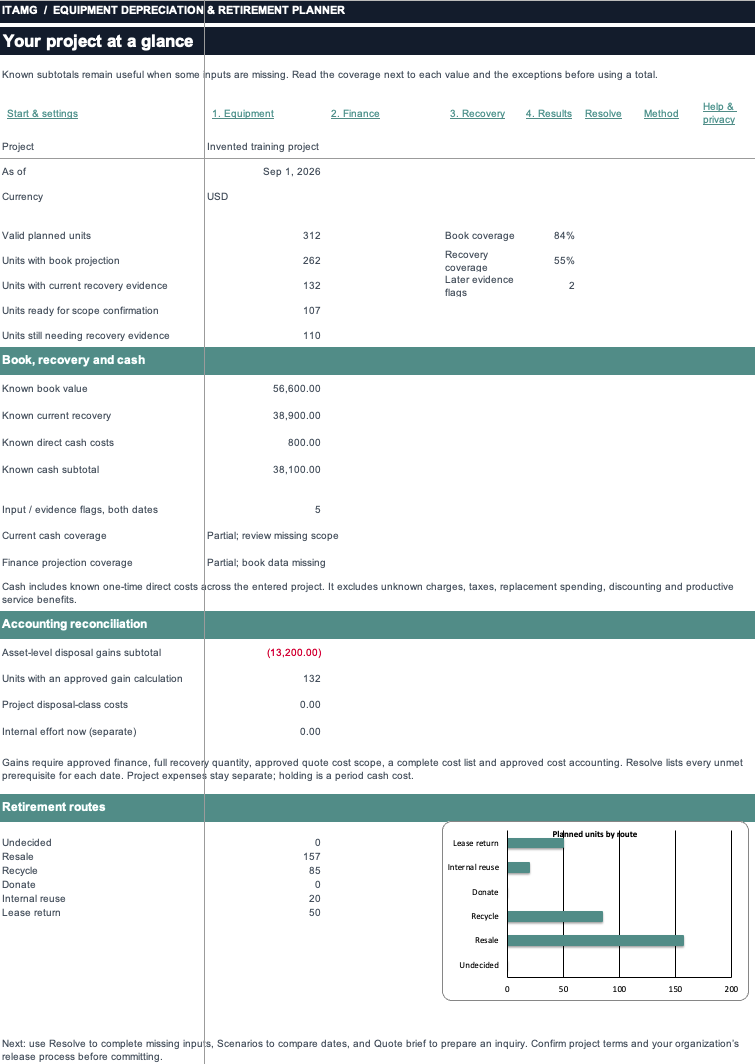
IT equipment dashboard: invented project totals
Plan IT equipment retirement in Excel
Use the blank calculator for your own business IT hardware. The separate example and PDF guide explain the workflow.
Download Excel CalculatorOpens in a new tabGet an IT equipment disposal quote from ITAMG
Request an IT Disposal QuoteITAMG prepares IT equipment disposal quotes from equipment types, quantities, condition, locations and release timing. Book values are optional. Share your project details through ITAMG's standard form below.
Your calculator inputs are not attached to the form. After a business inquiry, the thank-you page offers the option to book a meeting with ITAMG.
- Certified R2v3, NAID AAA, RIOS
- Aligned to NIST 800-88 Rev. 2
- Compliant SOC 2, HIPAA
Prefer to talk? Call ITAMG on (516) 681-3550.
IT equipment depreciation and retirement questions
Check the assumptions behind computer and server depreciation, interpret the results and prepare an IT equipment disposal inquiry.
What depreciation rate should I use for computers, laptops or servers?
Computer, laptop and server book depreciation depends on the useful life, residual value and method approved for your organization. The calculator does not choose a rate from the IT equipment category. Its 48-month example is an invented assumption, not a recommended life. Tax recovery periods and changes in resale prices are separate.
Can I use this as a computer or server depreciation calculator?
The calculator projects computer, laptop and server book value from your cost, residual value, useful life, start date, quantity and as-of date. Group IT equipment only when those assumptions match. For a mixed fleet, create separate equipment groups and add the finance records and quote evidence relevant to each.
What is the difference between book value and resale value?
IT equipment book value is its accounting carrying amount; resale value depends on what a buyer will pay for that equipment under stated terms. The planner keeps book projections and quoted proceeds separate. ITAMG assesses the equipment, condition, quantities, and market when preparing an offer. A book balance alone does not establish a resale price.
Does fully depreciated mean the equipment should be disposed of?
Fully depreciated IT equipment may still be useful, and a residual book value does not authorize disposal. Review service needs, replacement dependencies, internal reuse, ownership, release approval and data handling. The readiness check identifies unresolved facts and next actions. Your organization decides whether the equipment can be released.
Do I need finance records before asking ITAMG for a quote?
ITAMG can assess an IT equipment disposal inquiry without book values or finance records. Start with equipment types, quantities, locations, condition and release timing. Finance information supports your internal review. The calculator does not attach your inventory or financial inputs to the project inquiry form.
How does the planner treat a quote that is already net of fees?
A quote already net of fees supplies the settlement amount. Identify included charges so the planner excludes them from additional deductions. For revenue sharing, pre-split deductions come first, then the seller share, then post-split deductions. Check the quote terms and cost flags before relying on net cash recovery.
What does partial coverage mean in my results?
Partial coverage means a result covers only some planned equipment or required cost evidence. Review the uncovered quantities and exceptions, add or correct the missing inputs, and calculate again. Keep an unavailable quote or cost marked unknown; enter 0 only when you have confirmed zero.
Can leased IT equipment be sold at the end of its life?
The planner flags leased IT equipment selected for resale and shows lease return as a separate outcome. Confirm ownership and lease terms before deciding what happens to the hardware. The calculator does not determine sale rights or calculate lease accounting.
What happens to the data on retired computers and servers?
ITAMG offers data erasure and physical destruction for retired IT equipment, with processes aligned to NIST 800-88 Rev. 2. The project quote identifies the method, location and documentation. In the readiness check, unknown data status requires a confirmed handling plan before release.
Where does my inventory data go when I use this page?
The IT equipment calculator reads imported CSV files and calculates results in your browser. It does not send those inputs to ITAMG. Completing the download form sends your contact details; completing the project inquiry form sends the details you enter there. See how your data is used.
What should an IT equipment disposal inquiry include?
An IT equipment disposal inquiry should identify equipment types, quantities, locations, ownership, release timing and data handling requirements. Models and condition help ITAMG assess the project. Enter the details you want to share in the standard project form. Your calculator inputs are not attached automatically.
ITAMG services for retiring business IT equipment
ITAMG provides IT equipment buyback, IT asset disposition, data destruction, data center decommissioning and computer recycling. Choose the service that matches your hardware and disposal requirements, or use the guides to understand valuation and quote terms.
Sell Used IT Equipment
Recover value from retired servers, storage, and networking hardware.
IT Asset Disposition
Secure, certified ITAD for enterprise hardware retirement, with full chain of custody.
Data Destruction
On-site and off-site destruction to NIST 800-88, with serialized certificates.
Data Center Decommissioning
Equipment de-racking, secure removal, and documented custody for data center projects.
Computer Recycling
R2v3-certified recycling for hardware past resale, with documented downstream tracking.
IT equipment depreciation methods and sources
ITAMG's calculator uses the stated whole-month planning convention and the references below. Your organization sets the useful life, residual value and accounting treatment for its IT equipment. A hardware category alone does not determine them.
- AASB 116, December 2022 compilation, paragraphs 50 to 55 and 60 to 62, explains depreciation, residual value, useful life and method selection. This Australian standard incorporates IAS 16; it is an illustrative accounting reference, not a statement of U.S. GAAP.
- AASB 116 paragraph 55 explains why idle status alone does not stop depreciation. Paragraph 71 relates disposal gain or loss to net disposal proceeds and carrying amount. The planner's whole-anniversary-month convention and numeric limits are product choices, not rules prescribed by that standard.
- The IFRS Foundation's IAS 16 overview describes the standard's scope. Your finance team determines the applicable reporting framework and any impairment, revaluation or held-for-sale treatment outside this simple projection.
- IRS Publication 946 (2025) covers U.S. tax depreciation. IRS Publication 544 (2025) covers asset dispositions and tax gain, loss and recapture. Those tax calculations are outside this planner.
References rechecked September 15, 2026. Examples use invented inputs and are planning illustrations. Use your finance team's current policy and applicable accounting framework for reporting.
Request an IT equipment disposal quote
ITAMG can assess your business IT equipment, release timing and data handling requirements. Use the project form to request a free, no-obligation disposal quote.