
IT Equipment Buyback Pricing Models: Flat Rate vs Revenue Share vs Tiered
ITAD vendors price IT equipment buyback in three structures: flat rate per asset, revenue share on resale proceeds, and tiered pricing that mixes both per asset class. The model a vendor quotes determines who absorbs resale-market risk, who captures upside, and how predictable the seller's recovery becomes. This guide compares the three models, names the project shapes each is right for, explains the pre-split vs post-split deduction order that determines real seller net, and ties pricing structure to the cert framework that makes it auditable.
Three ways ITAD vendors price IT equipment buyback
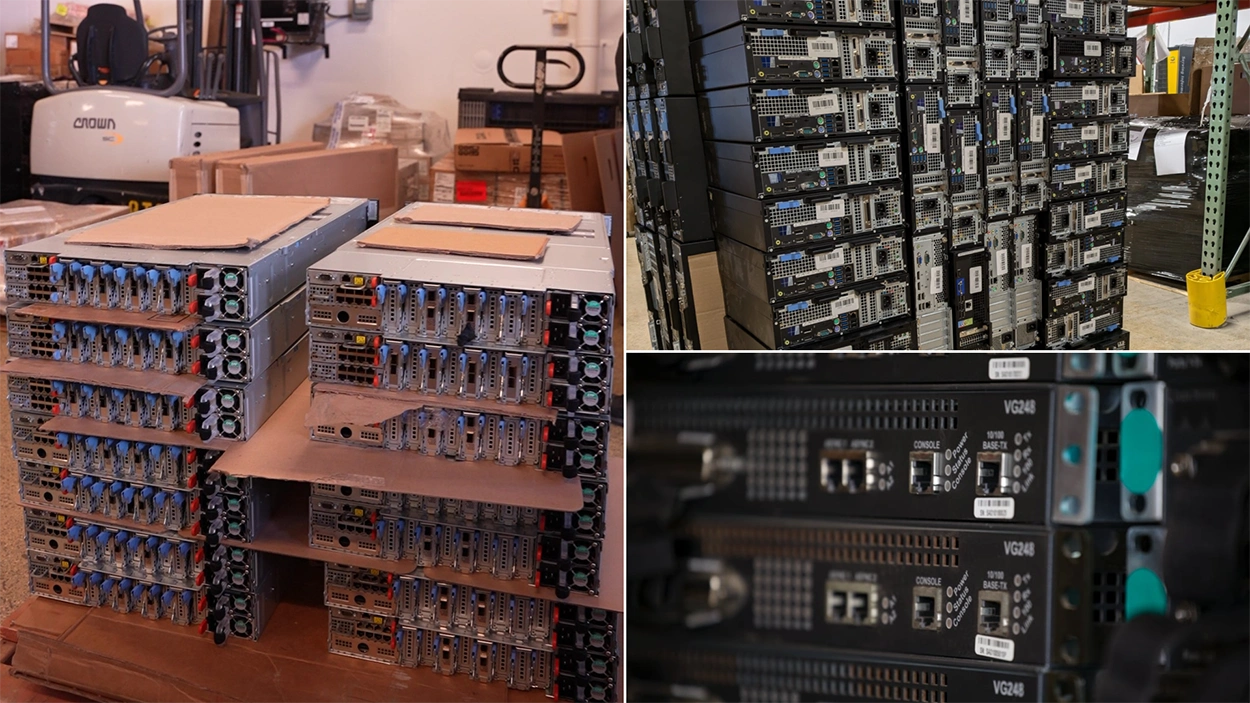
ITAD vendors price IT equipment buyback in three structures: flat rate per asset, revenue share on resale proceeds, and tiered pricing that mixes both per asset class. The IT asset disposition industry uses at least three naming conventions across vendor proposals, and the labels move even when the underlying structures stay the same.
One framing names per-unit, weight-based, project-based, and subscription. Another names revenue share or consignment, direct purchase or buyout, and fee-for-service. Most buyer-facing content names flat rate, revenue share, and tiered. The underlying structures are the same three; only the labels move.
This guide uses flat rate, revenue share, and tiered as the canonical framework. The structure a vendor quotes determines who absorbs resale-market risk and who captures resale upside. Pricing is also a separable concern from data destruction fees, logistics, and refurbishment costs. The model is about how resale value is shared; the line items for services are negotiated separately and should appear separately in the proposal.
Across vendor proposals, sellers commonly encounter these three structures under different labels. Sellers reading multiple vendor proposals see the same underlying model under three different names; reading proposals comparably requires translating the labels back to a single framework first.
Naming conventions reconciled
| Canonical (this guide) | Industry synonym | Industry synonym |
|---|---|---|
| Flat rate per asset | Per-unit pricing | Direct purchase or buyout |
| Revenue share | Consignment | Resale split |
| Tiered pricing | Hybrid pricing | Per-asset-class pricing |
Flat rate per asset buyback pricing for predictable inventory
Flat rate per asset is right for predictable-inventory projects where the seller values revenue certainty over resale-market upside. Under flat rate, the vendor quotes a fixed price per device class before pickup. A laptop in working condition might be one price, a 1U server another, a standard switch a third. The seller knows revenue at the quote stage; the vendor absorbs resale-market risk and captures resale upside.
Refresh-cycle disposition of standardized fleets fits flat rate well. A laptop refresh across a standardized fleet, a desktop refresh, a standardized server refresh. The seller wants a clean number to record against the capital recovery line of the disposition project. The vendor wants throughput. Both sides win when inventory is predictable and condition is consistent.
Flat rate is wrong for high-variance inventory, specialty hardware with strong resale demand, or projects where market timing favors the seller. A project that includes specialty AI compute, mainframes, or enterprise storage with unusually strong resale demand leaves money on the table under flat rate because the vendor captures the upside.
Documentation requirements at the proposal stage: per-device-class price list, a condition grading rubric (working, cosmetic damage, damaged, non-functional), and an exclusions list for non-resellable equipment. Use ITAMG's depreciation calculator for a per-asset value baseline before evaluating any flat rate quote, and review how vendors determine what equipment is worth for the underlying valuation methodology.
Revenue share buyback pricing for high-resale-value inventory
Revenue share, also called consignment, means the vendor resells the equipment and splits the proceeds with the seller at a documented percentage. Under revenue share, the equipment leaves the seller's facility but the seller retains an economic stake in the resale outcome. The vendor handles refurbishment, testing, listing, and resale. Once the equipment sells, the proceeds are split with the seller at a documented percentage.
Some industry sources call this model consignment; it is the same structure under a different label. Revenue share aligns vendor incentives with maximum resale price. The vendor earns more when the equipment sells for more; the seller does too. The vendor absorbs less risk than under flat rate because the vendor is not committing capital upfront; the seller absorbs more market risk in exchange for capturing resale upside.
Revenue share is right for high-resale-value inventory where the seller can tolerate variance in exchange for upside. Specialty hardware (AI compute clusters, GPU racks, mainframes, enterprise storage arrays) typically resells at multiples that justify the model. Revenue share is wrong for predictable inventory where the seller values certainty over variance, for urgent timelines (resale can take weeks to months), and for small lots where overhead is disproportionate to potential resale value.
Documentation requirements at the proposal stage: percentage breakdown stated in writing, deduction order (pre-split or post-split, covered in the next section), per-asset reporting cadence, and minimum-lot or minimum-resale-value thresholds. ITAMG's own revenue-share structure splits 70% to the seller and 30% to ITAMG on the resale pool after channel listing fees, shipping costs, ITAMG-added warranty, and value-added services such as maintenance contracts are deducted pre-split. The deductions list and the deduction order should both appear in writing in the MSA before equipment leaves the facility; a documented percentage is the floor, a documented deduction order is what makes that percentage meaningful.
Tiered ITAD pricing for mixed inventory
Tiered pricing applies different rates per asset class within a single engagement: flat rate on commodity hardware, revenue share on high-resale-value hardware, and a recycling fee on no-resale-value hardware. Tiered is the only structure that handles a mixed disposition project cleanly. A real-world refresh typically combines commodity laptops, mid-tier desktops, current-generation servers, end-of-life storage, broken devices, and obsolete printers in one project. A single pricing model forced across that inventory leaves either the seller or the vendor underwater on some segment.
Under tiered pricing, the vendor assigns a structure per asset class. Commodity hardware (laptops, desktops, basic networking) typically gets flat rate per asset, where condition and volume are predictable. High-resale-value hardware (servers, specialty hardware, enterprise storage) typically gets revenue share, where resale upside justifies variance. No-resale-value hardware (CRT monitors, broken devices, end-of-life printers) typically gets a recycling fee or a zero offer, because resale economics do not work.
Tiered pricing is right for mixed inventory across asset classes, for refresh-plus-decom-plus-EOL projects bundled in one engagement, and when the seller wants predictability on the easy fleet and upside on the hard fleet at the same time. Tiered engagements often include categories such as used servers and storage equipment, used IT networking equipment, and corporate laptop disposal. For enterprise-grade asset classes specifically, see the guide on how to sell or recycle enterprise servers.
Tiered is wrong for single-class inventory where one model already wins. A pure laptop refresh does not need tiering; a flat rate quote per laptop is simpler and equally efficient.
Documentation requirements at the proposal stage: per-asset-class structure assignment, per-class percentage breakdown where revenue share applies, per-class deduction order, cross-class reporting, and the exclusion list for no-resale-value items. Tiered structures are powerful, but only when each tier is documented separately.

Comparing flat rate, revenue share, and tiered buyback pricing
Flat rate works when inventory is predictable, revenue share works when resale upside is high, and tiered works when inventory is mixed across asset classes with different value profiles. Six criteria drive the right-model decision: inventory predictability, asset-class mix, resale-market state, seller risk tolerance, timeline urgency, and internal recovery reporting requirements. Each criterion pushes the decision toward a different structure.
The decision matrix below maps each criterion across the three models.
| Decision criterion | Flat rate per asset | Revenue share | Tiered pricing |
|---|---|---|---|
| Inventory predictability | Best when high | Tolerates variance | Required when mixed |
| Asset-class mix | Single class | Single class, high value | Multiple classes |
| Resale-market state | Vendor absorbs risk | Seller captures upside | Per-class allocation |
| Seller risk tolerance | Low (revenue certain) | Higher (variance accepted) | Medium (mixed exposure) |
| Timeline urgency | Strong (paid on pickup) | Weak (resale takes weeks) | Per-class timing |
| Reporting overhead | Light | Moderate | Heaviest |
A vendor's default quote may reflect standard fleet assumptions rather than the seller's exact asset mix. The only way to verify alignment is to request a second-model quote on the same inventory list and compare the projected net side by side.
Two caveats matter for the decision. First, the structure choice is per project, not per vendor. A vendor that quoted flat rate last year may quote tiered this year if the inventory shifted. Second, the structure name in the proposal is not the structure in operation; a "tiered" header above a single flat-rate price list is not tiered pricing. Read the body of the proposal, not the section heading.
Pre-split vs post-split deductions in revenue share buyback
In revenue share contracts, pre-split deductions subtract service costs before calculating the percentage split, while post-split deductions subtract after, and the difference materially changes the seller's net. The percentage in a revenue share contract means nothing without the deduction-order specification. A 70/30 split with post-split deductions can yield materially different seller net than a 60/40 split with pre-split deductions on the same gross resale. Many proposals do not make deduction order obvious unless the seller asks.
Pre-split deductions: the vendor subtracts service costs (logistics, data destruction, refurbishment, compliance documentation) from gross resale before calculating the percentage split. Both parties share in covering the project costs.
Post-split deductions: the vendor calculates the percentage split on gross resale first, then subtracts service costs from the seller's share only. The seller absorbs the full cost burden after the vendor's percentage is already locked.
Consider the following illustrative scenario. A device resells for $100. Service costs (channel listing fees, shipping, warranty, value-added services) total $40. The contract calls for a 70/30 split, seller to vendor.
| Step | Pre-split deductions | Post-split deductions |
|---|---|---|
| Gross resale | $100 | $100 |
| Service costs deducted from gross? | Yes, before split | No, deducted from seller share only |
| Net split base | $60 | $100 |
| Seller share at 70% | $42 | $70 |
| Vendor share at 30% | $18 | $30 |
| Service costs deducted from seller share? | No (already deducted from gross) | Yes ($40 from seller share) |
| Seller net | $42 | $30 |
The 70% headline looks the same in both columns; the seller net swings from $42 to $30 on the same transaction. The pre-split vs post-split distinction is structural, not cosmetic.
Audit the contract by asking the vendor to walk through a sample transaction line by line before signing. If the vendor cannot or will not show the math on paper, the contract is not finalized. Get the deduction order in writing before equipment leaves the facility.
Buyback pricing transparency as the real signal
Pricing transparency matters more than the pricing model itself: opaque pricing protects the vendor at the seller's expense regardless of which model the vendor quotes. The right question at the proposal stage is not "which model is best" but "which proposal is documented enough to verify." All three pricing models can be transparent or opaque. The model itself is not the signal; the documentation behind the model is.
Transparency markers in a proposal include a documented per-asset-class price list (for flat rate or the flat-rate tier), a documented percentage breakdown (for revenue share or the revenue-share tier), a documented deduction order, a documented exclusions list, a documented reporting cadence with serialized per-asset reporting, and documented audit access to the resale records.
Opacity markers include "all-in" pricing without scope-of-work definition, a percentage quoted without deduction order, single-line settlement without per-asset breakdown, reluctance to share reference clients of similar scale, and vague language around exclusions. For more on what a documented quote should contain, see the ITAMG knowledge base on what information is needed for a buyback quote.
A transparent flat-rate quote and a transparent revenue share quote are both viable; an opaque version of either is a red flag regardless of the headline number. Read the proposal for what is missing, not just for what is offered.
How ITAD certifications affect buyback pricing structure
R2v3 Certified, NAID AAA Certified, and RIOS Certified vendors operate under documented chain-of-custody and audit controls; buyers should request serialized per-asset reporting and documented deduction order in the proposal as a transparency requirement. Certifications govern data security, chain-of-custody documentation, and downstream recycling. They do not directly govern pricing structure. A certified vendor can quote flat rate, revenue share, or tiered. An uncertified vendor can quote the same structures. The structure is not the cert question.
What certifications do affect is the operational posture that makes pricing transparency practical. A vendor that is R2v3 Certified (the SERI standard for responsible recycling), NAID AAA Certified (the i-SIGMA standard for information destruction), and RIOS Certified (the responsible recycling industry standard) already operates under documented audit controls. Documented audit controls make serialized per-asset reporting practical to provide on request.
The buyer's job is to convert that operational posture into a transparency requirement at the proposal stage. Ask the vendor to confirm in writing whether serialized per-asset reporting is included in base pricing or itemized, whether chain-of-custody documentation (a NAID AAA Certified scope item) is in base pricing or itemized, and whether NIST 800-88 wipe documentation on devices with storage media is in base pricing or itemized.
Cert audit and compliance overhead affects vendor cost structure. Certified vendors carry that overhead; the buyer's trade-off is paying for documented auditability and downstream traceability that the cert framework underwrites. The trade-off is rational when the inventory contains regulated data or when the disposition project is auditable downstream. ITAMG holds R2v3 Certified, NAID AAA Certified, and RIOS Certified status.
Net recovery vs headline buyback pricing
Net recovery, the gross buyback offer minus project costs such as data destruction, logistics, refurbishment, and compliance documentation, is the CFO-grade metric for capital-recovery decisions, not headline pricing. Headline buyback price is the gross resale value or the vendor's offer. Net recovery is what hits the seller's balance sheet after subtracting project costs and adding back avoided costs (storage, security, liability exposure for retained equipment). The same headline price under different pricing models yields different net recovery once project costs are folded in.
Consider the following illustrative example. The same hypothetical inventory of 100 used laptops with a gross resale value of $10,000 is quoted under each of the three models, with a 70/30 seller-to-vendor split on the revenue-share portion.
| Component | Flat rate per asset | Revenue share (70/30 seller:vendor, pre-split) | Tiered (mixed) |
|---|---|---|---|
| Gross resale value | $10,000 | $10,000 | $10,000 |
| Service costs deducted pre-split | $0 (rolled into flat) | $2,500 (channel fees, shipping, warranty, VAS) | $1,000 (revenue-share tier only) |
| Pool available for split | n/a | $7,500 | $4,000 (revenue-share tier) |
| Seller pay calculation | $40 per asset × 100 = $4,000 flat | 70% × $7,500 = $5,250 | $2,000 flat (commodity) + 70% × $4,000 = $4,800 |
| Net recovery to seller | $4,000 | $5,250 | $4,800 |
Revenue share carries the highest net recovery in this illustrative scenario, but only because the resale price held at $10,000. If the resale market softens enough or itemized costs run higher than estimated, the seller's net under revenue share can drop below the $4,000 floor flat rate would have guaranteed. Flat rate trades upside for certainty; tiered captures upside on the high-resale-value portion while keeping certainty on commodity. The comparison is meaningless until project costs and resale risk are both folded in.
Tax treatment matters for the recovery basis. Capital recovery from disposed business IT equipment is reportable; the specific tax form depends on entity type and the basis classification of the equipment, and the determination is a tax-advisor decision rather than an ITAD-vendor decision. The IRS publishes guidance on disposition of business property that the seller's tax advisor uses as the starting point.
How to negotiate IT equipment buyback pricing pre-contract
Pricing model, percentage breakdown, deduction order, and exclusions for no-resale-value equipment must all appear in writing in the Master Service Agreement before equipment leaves the seller's facility. Pre-contract is the only leverage window. Once equipment leaves the facility, the seller has no meaningful negotiation position; the vendor controls the timeline, the resale records, and the settlement math. Lock the terms before pickup.
Five items must appear in writing in the Master Service Agreement:
- Pricing model named explicitly (flat rate per asset, revenue share, or tiered). "All-in" pricing without scope definition is not a model.
- Percentage breakdown if revenue share or tiered, with documented deduction order (pre-split or post-split).
- Exclusions list naming what is priced at zero offer or recycling fee, by asset class or condition grade.
- Reporting cadence with serialized per-asset reporting at agreed frequency, plus audit access to the resale records on request.
- Vendor underperformance remedy (settlement credit, contract termination, or indemnification on underperformance).
Multi-vendor benchmark: request quotes from at least three certified ITAD vendors using the same inventory list and the same compliance requirements. Comparable inputs are what make the comparison meaningful. A quote from one vendor on raw inventory versus another vendor on inventory with NIST 800-88 wipe documentation included is not a comparison; it is two different scopes priced differently.
To start the comparison process under a transparent framework, request a documented buyback quote and require the vendor to specify pricing model, percentage breakdown, deduction order, and exclusions in writing as part of the proposal.
Frequently asked questions
Quick answers to the questions buyers, compliance teams, and IT leaders ask most often about this topic.