39-worksheet Excel planner
Use 33 working registers for sites, equipment, media, vendors, tasks, costs and evidence. Instructions, legends and dropdowns guide entries.

Data center decommissioning plan resources from ITAMG help infrastructure, security and facilities teams organize equipment retirement from initial inventory through final sign-off. ITAMG brings together an eight-step decommissioning checklist, a 39-worksheet Excel planner, a 36-page PDF guide and a completed project example for single-site, colocation and multi-site projects.
A data center equipment inventory connects each server, storage array and network switch to its site, rack, owner and planned destination. The planner links assets to HDDs, SSDs and other data-bearing media, so your team can distinguish equipment approved for reuse, resale, lease return or recycling from items awaiting a decision or release from a hold.
Shutdown and removal planning brings application migration, backup checks, change approvals and vendor schedules into one sequence. Track access windows, loading routes, rack and PDU removal, power and cooling dependencies, and colocation handback requirements. Assign the IT, security, facilities and vendor owners responsible for each decision before equipment leaves the rack.
The Excel decommissioning template carries those decisions into project execution: site and vendor coordination, task dates, asset status, costs, custody transfers, data treatment results and closeout evidence. Instructions, legends and dropdown choices guide your entries. Use the separate fictional example to see how linked records document completed work, held equipment and unresolved exceptions.
Plan equipment retirement, facility exits and phased removals.
Servers, storage and network equipment
Connect equipment inventories, rack locations and data-bearing media.
Facilities, schedules and vendors
Coordinate racks, PDUs, site access and power or cooling dependencies.
Asset custody and project closeout
Track transfers, treatment records, exceptions and final approvals.
Plan with ITAMG
Align your equipment inventory, removal schedule and reporting requirements before work begins. Discuss a single rack, a colocation exit or a coordinated multi-site retirement.
Tell us who to contact about your project.
All fields are required.
Complete your contact details and choose a service type and request type.
The consultation form could not load. Please contact ITAMG to discuss your project. Discuss your project with ITAMG
Business requests continue to the thank-you page, where you can schedule a consultation or share project details.
“The ease of planning and execution cannot be understated. They made it easy to set up and get the project done.”
Excel, PDF and example
Build your decommissioning plan in Excel, with a guide that explains the decisions and a completed example that shows how to record them.
Use 33 working registers for sites, equipment, media, vendors, tasks, costs and evidence. Instructions, legends and dropdowns guide entries.
Follow the planning sequence from scope and equipment inventory through removal, data treatment, reconciliation and final acceptance.
See connected sites, assets and media, including held items, failed treatment attempts and unresolved evidence.
Data center planning toolkit
ITAMG
Plan your data center equipment retirement.
The planning sequence
A data center decommissioning plan defines the scope, owners, sequence, approvals and evidence for retiring equipment or exiting a facility. Use these eight checkpoints from initial scoping through closeout.
01 / 08
Decision or record to prepare
List facilities, rooms, racks, servers, storage and network equipment. Agree what stays, moves or retires, and assign accountable owners.
Check physical inventory against asset records. Link equipment to its HDDs, SSDs and other media; flag missing items, leases and ownership questions.
Confirm workload migration, backups, rollback criteria and change windows. Assign qualified owners for electrical isolation, PDUs and cooling dependencies.
Choose reuse, resale, return or recycling. Have the security owner approve media treatment, legal-hold releases and acceptance requirements.
Define removal, sanitization, transport and processing responsibilities. Confirm site access, loading routes, insurance and vendor reporting requirements.
Assign tasks, dependencies, maintenance windows and contingencies. Budget labor, packing, transport and facility handback obligations.
Record packing, treatment attempts and transfers. Reconcile equipment leaving each site with receipts; investigate held, failed or missing items.
Match certificates to asset and media records. Resolve discrepancies, reconcile costs and proceeds, and obtain project and facility sign-offs.
Use the checklist as a planning sequence. Your team still sets the technical procedures, safety requirements and approval rules for each site.
For media sanitization, consult NIST SP 800-88 Rev. 2 alongside your organization's security and retention requirements.
Connected project records
Follow each equipment record from its site and removal wave through treatment, custody and evidence acceptance. Keep unresolved work visible before approving closeout.
Connect site IDs, accountable people, vendors, tasks, risks and decisions across one facility or a multi-site program.
Track servers and other equipment separately from their data-bearing media. Record each treatment attempt and its result.
Link transfers, vendor evidence, exceptions and approvals. Resolve discrepancies before accepting the relevant records.
See the completed example
Enlarge preview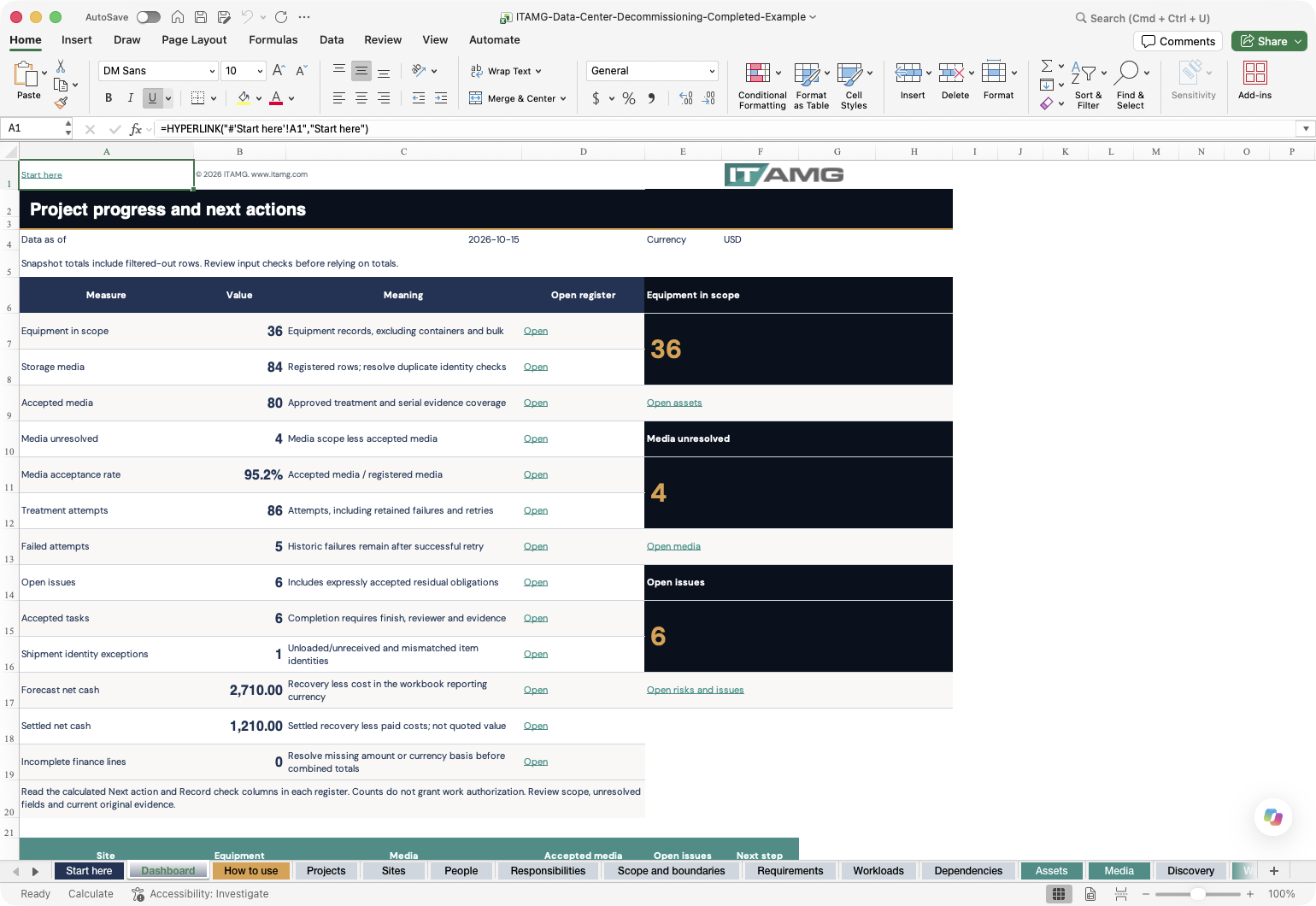
Schedule and budget
Map the constraints that control each removal wave. Equipment count alone will not determine the completion date or total cost.
Account for migration readiness, legal holds, maintenance windows, site access, vendor capacity, transport and evidence acceptance. Add power, cooling and facility handback dependencies where they apply.
Budget labor, packing, data treatment, transport, recycling and facility restoration. Keep estimated equipment resale value separate from confirmed proceeds and allow for unresolved work.
Selecting a vendor? Use the ITAD RFP guide to define the scope, reporting and commercial requirements.
Planning questions
A useful template covers scope, site contacts, asset and media inventories, dependencies, disposition decisions, vendors, tasks, budget, custody, exceptions and final approvals. ITAMG's workbook provides registers for these areas, with instructions and linked record IDs.
Yes. Use separate site records and connect the relevant assets, vendors and tasks to each site. For colocation, add provider access, lease obligations and handback requirements. For a large campus or hyperscale program, confirm the workbook fits your team's volume and collaboration needs before adopting it.
Start with the workbook's first-use instructions and define your project scope. Use the relevant registers and document items that do not apply. The separate example shows completed entries so a first-time user can understand the relationships before entering live project data.
It uses controlled status choices and linked records for equipment, media, treatment, custody and evidence. This helps distinguish a scheduled asset, a held item, a treatment failure and accepted evidence. Your team updates the records and resolves exceptions; the workbook does not discover assets or sanitize media.
Group equipment into removal waves and connect each wave to its site, owners, vendors and tasks. Record the readiness checks, approved work window and custody handoff for each wave. Keep held assets and unresolved media visible so a completed pickup does not hide unfinished work.
It helps your team plan, coordinate and document the project. Application shutdowns, electrical work, lifting, transport and media treatment still need qualified owners, approved procedures and the right equipment. ITAMG can discuss the execution and reporting scope for your project.
Discuss your scope
Bring your equipment scope, site requirements and target dates. Discuss the removal, data destruction and reporting support your project needs.
More From ITAMG
Connect your project plan with ITAMG services for equipment disposition, data destruction and value recovery.
Secure, certified ITAD for enterprise hardware retirement, with full chain of custody.
Learn moreOn-site and off-site destruction to NIST 800‑88, with serialized certificates.
Learn moreRecover value from retired servers, storage, and networking hardware.
Learn moreRatings reflect ITAMG service experiences. Gartner rating checked September 17, 2026. Google rating checked September 17, 2026.
GARTNER is a registered trademark and service mark of Gartner, Inc. and/or its affiliates in the U.S. and internationally, and PEER INSIGHTS is a registered trademark of Gartner, Inc. and/or its affiliates and are used herein with permission. All rights reserved. Gartner Peer Insights content consists of the opinions of individual end users based on their own experiences with the vendors listed on the platform, should not be construed as statements of fact, nor do they represent the views of Gartner or its affiliates. Gartner does not endorse any vendor, product or service depicted in this content nor makes any warranties, expressed or implied, with respect to this content, about its accuracy or completeness, including any warranties of merchantability or fitness for a particular purpose.