
NAID AAA Certification Explained: What It Verifies and Why It Matters
NAID AAA Certification is the data destruction industry's most recognized proof that a vendor does what it claims. i-SIGMA, the certifying body, issues it. Outside auditors test the vendor's security controls, staff screening, destruction methods, and chain of custody through scheduled and surprise audits. For an enterprise picking a data destruction or ITAD partner, this credential separates audited security from sales talk. This guide explains what the certification verifies, what it does not, and how to check a vendor's claim before you hand over regulated data.
What Is NAID AAA Certification?
NAID AAA Certification is a third-party program. It confirms that a data destruction vendor meets strict, written security standards. It is the industry's most recognized destruction credential, earned only by passing outside audits.
NAID stands for the National Association for Information Destruction. The "AAA" is the tier a provider holds, not a grade it gives itself. Auditors check the provider against a published manual. Then they confirm the controls work in real life.
Any vendor can promise secure shredding on a sales call. NAID AAA turns that promise into something an outside auditor has tested.
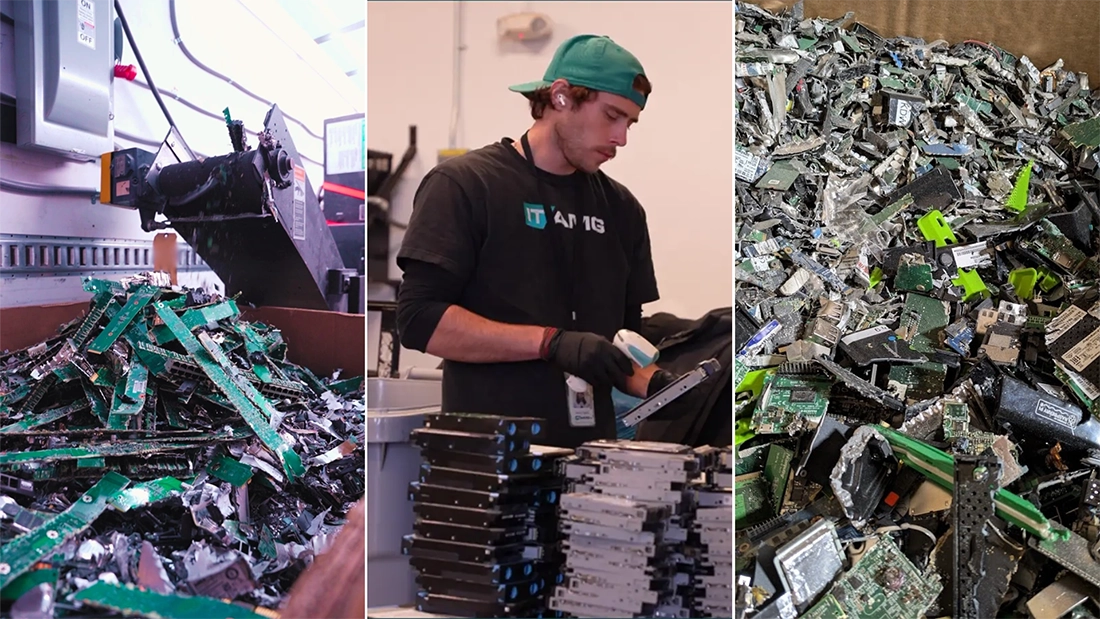
ITAMG holds NAID AAA Certified status, shown in ITAMG's on-site data erasure walkthrough, so an enterprise can ask for the same audited assurances this guide describes. If you are new to the topic, ITAMG's overview of data destruction methods and fundamentals is a useful starting point.
Who Issues NAID AAA, and What Is i-SIGMA?
i-SIGMA issues and audits the certification. The full name is the International Secure Information Governance and Management Association. It runs the program, trains the auditors, and keeps the registry of certified providers.
i-SIGMA was formed when NAID merged with PRISM International, joining secure destruction and records management under one body. The NAID name lives on because buyers already know it and ask for it.
According to i-SIGMA's NAID AAA Certification program, certified companies are checked against documented security standards. Auditors confirm the protocols are followed. A Certification Committee provides oversight.
A vendor can be an i-SIGMA member without being certified. As i-SIGMA's certification FAQs state, a company must be a member to apply, but membership and certification are separate. Membership is a subscription. Certification is an audited result. So "NAID member" and "NAID AAA Certified" are two very different claims.
What Does a NAID AAA Audit Actually Verify?
A NAID AAA audit verifies that a provider's controls, staff, methods, and records meet i-SIGMA's written standard. It tests real operations, not just paperwork.
The program covers physical destruction and electronic media destruction. It checks security measures such as CCTV retention, staff screening, and written procedures. Auditors also confirm secure handling and transport through to final destruction.
The audit is not a one-time check. Certified providers face scheduled and surprise reviews. So the controls have to hold up on an ordinary day, not just on an inspection day. That ongoing pressure gives the credential its weight.
In ITAMG's experience, buyers underrate how much the audit focuses on people and custody. Background screening, controlled access, and an unbroken chain of custody often matter more to a regulator than the shredder.
The 6-Control NAID AAA Verification Checklist for Buyers
The fastest way to use this certification is to break it into the six controls the audit checks, then test each against your own needs. The table below is a buyer checklist drawn from i-SIGMA's audited program areas.
| # | Control NAID AAA verifies | What to confirm before you sign |
|---|---|---|
| 1 | Scope and endorsements (mobile versus plant-based; physical destruction versus electronic data erasure) | The certificate lists the exact service you need, on the media type you actually handle |
| 2 | Employee access controls and background screening | Every worker who touches your media is screened and access-controlled under the audited program |
| 3 | Destruction-method validation (particle size for physical destruction; verified method for erasure) | The method matches your data sensitivity and any regulator or contract requirement |
| 4 | Scheduled and unannounced third-party audits by i-SIGMA | The certification is current in the i-SIGMA registry, not just claimed on a brochure |
| 5 | Chain of custody from collection through final destruction | Custody is documented at every handoff, including transport to the destruction point |
| 6 | A defensible certificate of destruction | The certificate identifies the media, method, service date, and responsible party |
Work the table top to bottom. Rows one to three tell you whether the certification fits your media and your risk. Rows four to six tell you whether the assurance is real and provable after the job. A weak answer on any row points to a control area that needs further diligence before you sign.
NAID AAA Scope: Mobile, Plant, Destruction, and Erasure
This certification is scoped by service category. A certificate is only as useful as the endorsements attached to it. Two vendors can both be certified, yet for completely different services.
The program covers physical destruction and electronic media destruction. Endorsements then narrow the scope. They define whether the service is mobile (done on-site) or plant-based (done at the facility). They also list the media types, such as paper, hard drives, and solid state devices.
This is where many buyers slip. A vendor certified for mobile paper shredding is not automatically certified for hard drive destruction, and may not cover data erasure on reusable drives either. Each is a separate endorsement with its own audited rules.
Match the endorsement to your data, not to the logo. For on-site hard drive shredding during a data center refresh, confirm the mobile physical-destruction endorsement for that media. To resell working drives, you need verified erasure, which is a different capability. ITAMG offers on-site shredding with mobile equipment, so large jobs need not leave your building. Confirm that the mobile equipment and endorsements cover the exact media and method you need. The rule holds for any vendor: read the endorsements, not just the name.
Why Unannounced Audits Define the Credential
Unannounced audits are the one feature that sets this certification apart from a self-written security policy. They prove the controls work every day, not just when a provider expects a visit.
A scheduled audit measures a provider on its best behavior. A surprise audit measures the same provider on a normal day, when staff are busy and shortcuts tempt. A provider cannot prepare for a visit it does not see coming. That is why i-SIGMA runs unannounced audits alongside scheduled ones.
For buyers, this is what makes the credential trustworthy. It is not a certificate on a wall but a standing promise to open the doors at any time. An outside auditor can then check the chain of custody, the screening records, and the process in real conditions.
When you weigh a NAID AAA Certified vendor, treat the surprise audit as a feature you are buying. It is why the credential beats an internal policy a provider wrote for itself, since the pressure is constant. That audit pressure is the practical compliance value of the credential.
NAID AAA vs NIST SP 800-88
NAID AAA and NIST SP 800-88 answer two different questions. NIST defines how to wipe or destroy media correctly. NAID AAA checks that a vendor follows a secure, audited process while doing it. You want both.
NIST Special Publication 800-88 Revision 2 is the federal guide for media sanitization. It defines three levels: Clear, Purge, and Destroy. Clear is basic overwriting for reuse inside the same security boundary. Purge uses stronger methods, such as cryptographic erase, when media leaves your control. Destroy makes the media and its data permanently unrecoverable.
NIST tells you which method fits your data. It does not audit the company doing the work. That is the job NAID AAA does, confirming the vendor's controls, staff, and custody around whatever method you pick.
The strongest position pairs them. A vendor should wipe or destroy to the right NIST level, then prove its process is secure through NAID AAA. ITAMG is NIST SP 800-88 Aligned and NAID AAA Certified, so the method and the audited process come together. ITAMG's NIST 800-88 alignment explains how the levels map to disposal choices.
How NAID AAA Fits the Triple-Certification Stack with R2v3 and RIOS
NAID AAA covers secure destruction. A complete ITAD program needs two more credentials. R2v3 covers responsible recycling and reuse. RIOS covers the operating management system. Together they form a triple-certification stack, and each one proves something the others do not.
NAID AAA Certified is the data-security layer. It verifies that destruction and erasure happen under audited controls, screening, and custody. This is the credential that protects the data on your retired assets.
R2v3 is the recycling layer. R2v3, run by SERI, governs reuse, refurbishment, and downstream material handling. It now controls its own data sanitization rules through Appendix B. A buyer should look for a vendor certified to the data sanitization parts of R2v3, not only the recycling chain. ITAMG's guide on what R2v3 certification means explains the appendix structure.
RIOS is the operations layer. RIOS, the Recycling Industry Operating Standard, brings quality, environmental, and health and safety management into one system. ITAMG holds NAID AAA Certified, R2v3 Certified, and RIOS Certified. So one vendor can prove data security, responsible recycling, and sound operations together, rather than across three suppliers.
What a Defensible Certificate of Destruction Must Contain
A certificate of destruction proves the work happened. It is only useful if it can survive an audit. The certification confirms that a provider issues solid certificates as part of its audited process.
A certificate should name the media destroyed, the method used, the date of service, and the party responsible. Without those details, it is a receipt, not evidence. Regulators look for specifics a generic note cannot tie back to your assets.
Strong providers go further than one project-level certificate. In ITAMG's practice, the records can include serialized asset reports for each item, a project-level certificate, and drive-by-drive erasure reports when media is wiped. That layered record lets a compliance team show exactly what happened to each device.
Treat the certificate as the deliverable you are really buying. To see the format that holds up, read ITAMG's explainer on what a certificate of destruction is. Then review the steps for how to get a data destruction certificate for your own assets.
How to Verify a Vendor's NAID AAA Claim
Do not take a NAID AAA claim at face value. Check it directly. A logo on a website is not proof that a certification is current or relevant.
Start with the i-SIGMA member registry. The association keeps the authoritative list of certified providers. Confirm the vendor appears there and that the status is active. A lapsed or pending status is not the same as certified.
Next, check the endorsements. Confirm the certification covers the exact service and media you need. That could be mobile hard drive destruction, plant-based shredding, or verified erasure. A certificate for one category does not cover them all.
Finally, ask for a sample certificate of destruction and a summary of the chain-of-custody process. A NAID AAA Certified provider hands over both without friction, because both are part of the audited program. Run these checks on every shortlisted provider, as part of a wider vendor review that ITAMG covers in the guide on how to select an IT asset disposition vendor.
NAID AAA and Your Compliance Obligations
The credential supports your compliance duties. It does not replace them. The certification helps show due diligence when you dispose of regulated data, and that evidence matters across several US rules.
Laws such as HIPAA, the Gramm-Leach-Bliley Act, and the FACTA Disposal Rule generally call for reasonable safeguards and disposal controls for covered information, not one specific certification. A NAID AAA Certified vendor gives you an audited process and a solid paper trail, the kind of evidence these rules favor.
It is worth clearing up a common myth. HIPAA does not require every drive to be physically destroyed. It requires reasonable safeguards against exposure of protected health information on disposed media. Documented erasure can meet that duty just as destruction can.
Use the certification as support, not a substitute for your own program. Your team still owns the disposal policy and the vendor choice. NAID AAA adds audited assurance from the partner handling your media.
What NAID AAA Does Not Prove
The certification proves a provider's destruction process is secure and audited. It does not prove everything, and an honest buyer should know the limits.
The credential does not, on its own, confirm responsible recycling of the leftover materials. That assurance comes primarily from R2v3, supported by RIOS for the provider's operating management system. This is why the triple-certification stack matters for a full ITAD job.
It also does not cover scope you never checked. A NAID AAA Certified provider can still be uncertified for the exact service you need, because a certificate is bounded by its endorsements. The credential answers "is this provider's destruction secure," not "is it certified for my job."
Finally, certification is a point-in-time status that must stay current. A vendor that lapsed no longer holds the claim. Used well, the certification is a strong filter that removes unaudited vendors from your shortlist. It is the floor for a serious data destruction partner, not the whole review.
Frequently asked questions
Quick answers to the questions buyers, compliance teams, and IT leaders ask most often about this topic.