
Data Center Liquidation: How to Sell Decommissioned IT Equipment, Servers, and Hardware
Data center liquidation is the structured resale and certified disposition of decommissioned IT equipment, servers, storage, networking, racks, PDUs, and UPS systems from a data center facility. The triggers are familiar: full-floor decommissions, partial retirements, colocation exits, cloud-migration phase-outs, or hyperscaler refresh waves. Selling decommissioned data center equipment runs as a logistics-first project with per-equipment-class economics that drive recovery and an audit-trail at fleet scale across used data center equipment inventory. This guide covers the DC-specific logistics, the equipment-class resale economics for used data center equipment, five case-pattern scenarios, and the audit-trail requirements under NAID AAA Certified chain-of-custody plus R2v3 + RIOS Certified data center equipment recycling.
What data center liquidation involves: selling decommissioned IT equipment
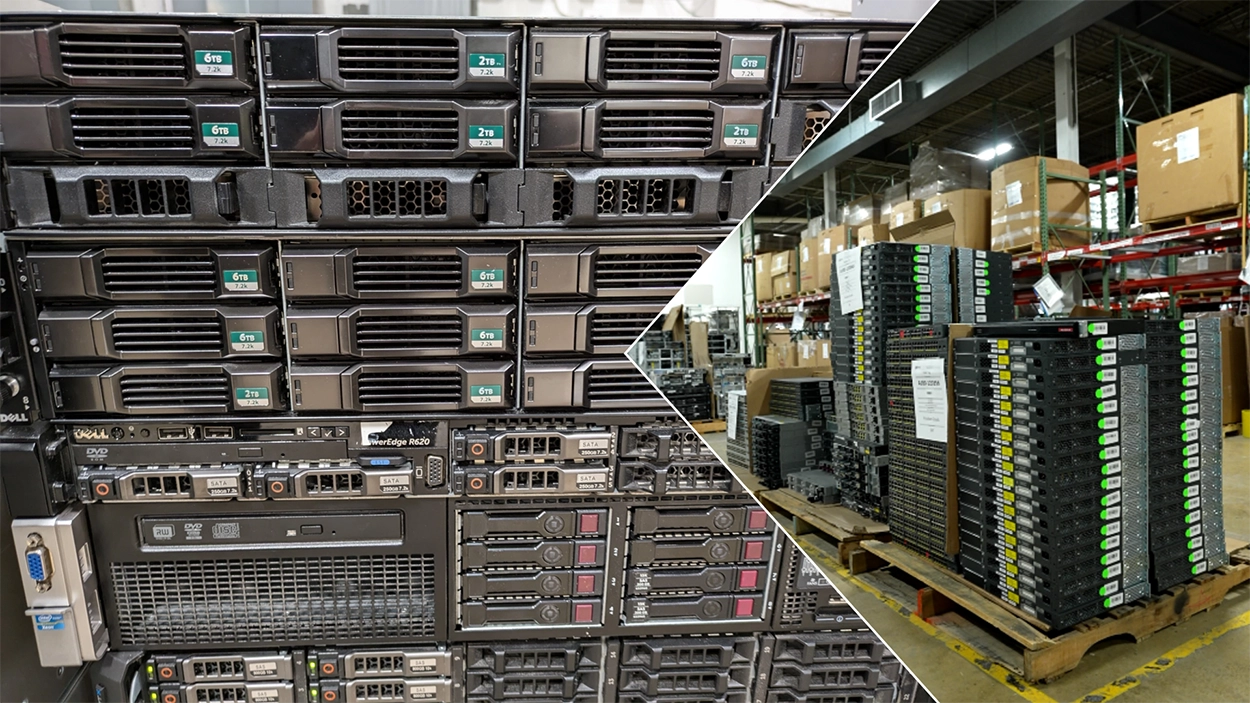
Data center liquidation runs from physical decommissioning of IT equipment through logistics handoff to ITAD-vendor processing, with per-asset audit trail across hundreds or thousands of devices under NAID AAA Certified chain-of-custody. The work breaks into four phases. Physical decommissioning (uncabling, racking-out, packaging) of decommissioned IT hardware is typically performed by IT and facilities staff or a DC-decom vendor. DC-specific logistics covers pallet jack movement, palletization, freight-class designation, multi-day pickup, certificates of insurance, and building-management coordination for the data center equipment removal.
Chain-of-custody handoff to a NAID AAA + R2v3 + RIOS Certified ITAD vendor closes the on-site project. Vendor-side processing of the used data center equipment includes serialized inventory receipt, certified data destruction where required, disposition routing to resale or data center equipment recycling, settlement, and audit-trail closeout at fleet scale.
For broader context on the parent process, see ITAMG's data center decommissioning services hub and the maximizing asset recovery value in data center decommissioning companion article. The data center liquidation process described below covers the resale-and-disposition slice; to sell data center equipment outside the full-decom context, the sell used IT equipment hub covers the broader cross-segment buyback program, and the IT liquidation guide covers cross-segment fundamentals.
DC-specific logistics: pallet jacks, freight, multi-day pickup
DC-specific logistics is the operational backbone of data center liquidation, and audit-grade ITAD vendors coordinate pallet jack movement, freight-class palletization, multi-day pickup, COI, building-management approval, and loading-dock scheduling as part of the engagement.
Data center freight is not office-IT freight. Pallet jacks (not forklifts) are the standard movement equipment inside data centers and colocation facilities. Most sites do not provide forklifts for vendor use, and forklifts on the data center floor create access and liability constraints. Equipment routes through specific freight doors with weight ratings and clearance constraints, with facility-provided forklift loading at the dock side where the facility supports it. Palletization standards run to shrink-wrap and edge-protection on every pallet, with pallet ID printing for serialized tracking. Freight-class designation varies by equipment type, with commodity-electronics ranges typical for servers and variable by chassis or enclosure for networking and storage.
Pickup duration is scope-driven. Single-service-day pickups are realistic when the scope is contained, such as a partial-rack pull, a small networking refresh, or a contained inventory list. Full-floor decommissioning, multi-site rollouts, and projects requiring extensive de-racking, cable management, or onsite data destruction run multi-day to multi-week. Certificates of insurance, building-management approval letters, and loading-dock scheduling all run on lead times that the project plan must absorb upfront. Trucks staged outside often cannot idle inside a loading dock during loading, which constrains scheduling tightly.
The freight is palletized, shrink-wrapped, and road-ready before the vehicle leaves the facility. Sealed multi-vehicle transport with GPS tracking is deployed for full-floor decoms when the scope warrants the chain-of-custody overhead; truck count varies with scope.
| Logistics element | Typical requirement | Who coordinates |
|---|---|---|
| Pallet jack movement | Rack-to-dock pallet jacks (standard); dock-side forklift only when facility provides | ITAD vendor + facilities |
| Palletization | Shrink-wrap, edge protection, pallet ID printing | ITAD vendor |
| Freight class | Per equipment type, commodity-electronics typical for servers | ITAD vendor |
| Multi-day pickup | Scope-driven; single-day for contained scopes, multi-day to multi-week for full-floor decom | ITAD vendor + IT operations |
| Certificates of insurance | Facility-specific limits, lead time required | ITAD vendor to facility |
| Building-management approval | Loading-dock slot, security check-in, escort | Facilities to ITAD vendor |
| Sealed multi-vehicle transport | GPS-tracked, chain-of-custody sealed; truck count varies with scope | ITAD vendor |
Pre-engagement site survey. Before pickup day, the ITAD vendor confirms site-specific operational constraints with the facility. The standard pre-engagement checklist covers:
- Trailer access plus any trailer-height or size restrictions
- Grades, ramps, or other obstacles between the dock and the data center area
- Whether pallets are permitted inside the working area
- Whether temporary cardboard (corrugated boxes for cable packing) is permitted in the data center
- Packing-material restrictions
- Other access restrictions
- Pallet-size restrictions from the rack area to the load area or dock
- Pallet-jack availability onsite
- Availability of any other lifts or equipment provided by the facility
- Staging area location and any related restrictions
- Responsibility for powering equipment down
- Site escort and access responsibility
Sites with regulated workloads (HIPAA, GLBA, SOX, PCI DSS, NIST 800-171, ITAR) layer additional access controls on top of the standard checklist.
Equipment-class economics: servers
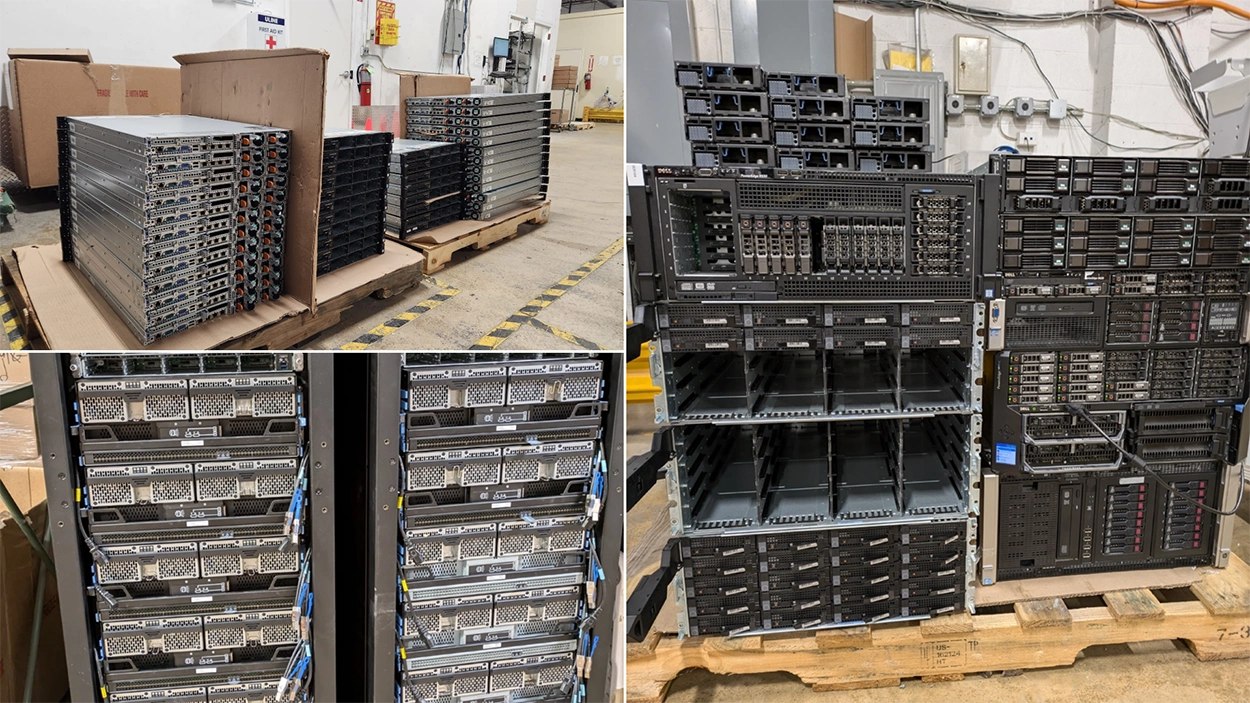
Used servers typically deliver strong resale across generation-current and one-generation-back hardware, with CPU SKU, RAM density, drive class, and GPU presence driving per-unit recovery. Dell PowerEdge, HPE ProLiant, Cisco UCS, Lenovo ThinkSystem, and Supermicro all have established secondary markets. Sustained buyer demand exists for used Dell servers, with used Dell PowerEdge server inventory in particular pulling strong bids. Used HPE servers (especially used HPE ProLiant server configurations) move quickly through ITAD buyer channels and server buyback program tiers.
The configuration matters more than the chassis: a populated PowerEdge with high-RAM-density modules and current-gen Xeon SKUs commands materially stronger recovery than a base-spec chassis of the same model line. GPU-equipped servers (especially with current-cycle NVIDIA accelerator cards) sit in a separate, much-higher-value resale tier within the broader used data center equipment market.
Documentation premium applies at scale. Serialized inventory with model, configuration, and condition notes lifts gross recovery against ad-hoc disposal. ITAMG's server-resale workflow helps organizations sell server equipment and decommissioned servers across vendors, while the enterprise server resale process covers the equipment-class detail end-to-end.
Equipment-class economics: storage, networking, power, racks
Equipment classes outside servers have distinct dynamics across used data center equipment categories: storage vendor profiles, networking generation sensitivity, UPS battery economics, and used server rack scrap value.
Used storage carries vendor lock-in dynamics that servers do not. Dell EMC, NetApp, Pure Storage, HPE Nimble, and IBM each have distinct resale profiles. Generation gap erodes value faster than on commodity compute hardware, and drive arrays often disposition into refurbishment channels rather than direct resale, with the storage frame and the drives often settling on different paths.
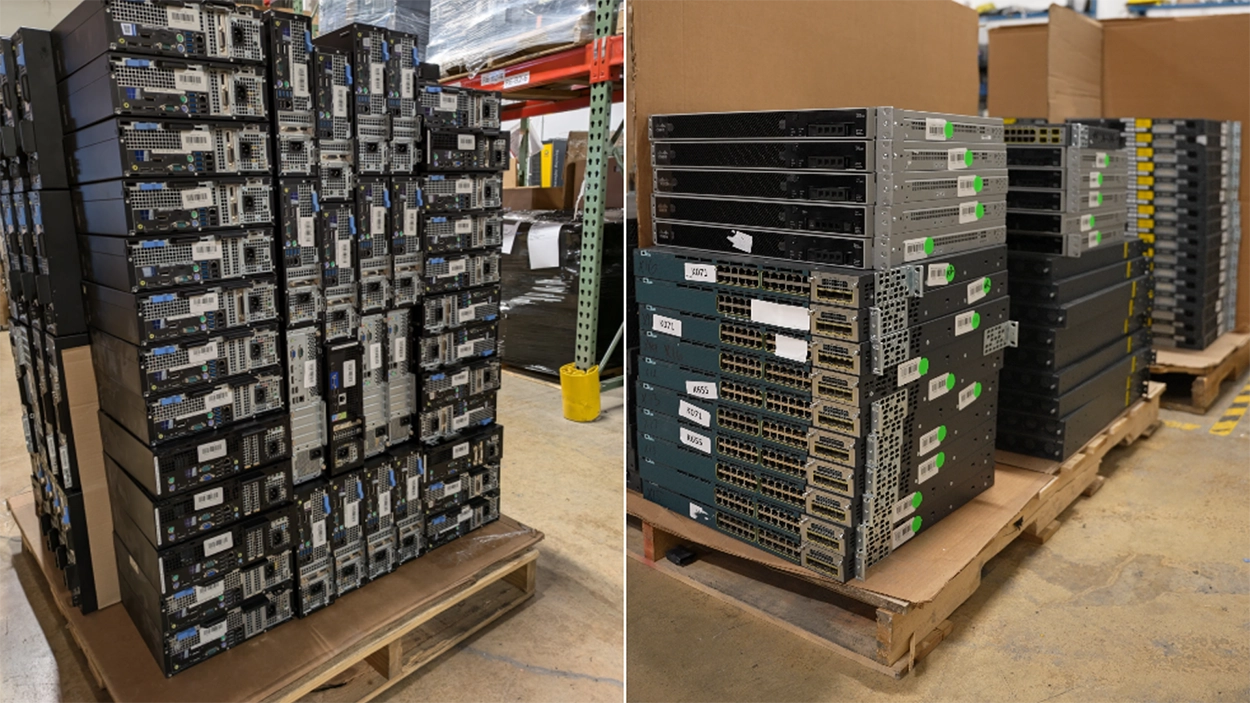
Used networking command-class equipment (Cisco Catalyst and Nexus, Juniper QFX and EX series, Arista, Extreme) holds value well at current-generation with active Smart Net Total Care or equivalent licensing transfer. Out-of-support gear drops materially.
PDU and UPS reach specialized buyers in a focused server buyback program tier (APC, Eaton, Vertiv recognized brands), with battery condition driving UPS recovery sharply: degraded batteries can flip a unit from resale to disposition cost. Used server racks settle at scrap value in most scenarios. The bulk of standard 42U and 48U enclosures from full-floor decoms scrap rather than resell, with newer-design intelligent racks the occasional exception. Cabling typically scraps and routes to commodity recycling.
The combined effect: the same data center floor produces materially different per-asset recovery depending on the equipment-class mix of used data center equipment on the floor, which is why pre-quote inventory is essential for accurate resale projections.
| Equipment class | Typical resale profile | Key variables | Specialized handling |
|---|---|---|---|
| Servers | Strong on current and one-gen-back | CPU SKU, RAM, drives, GPU | Standard ITAD pathway |
| Storage | Variable; vendor-lock erodes faster | Vendor, generation, drive count | Drive disposition often separate |
| Networking | Strong on current with active licensing | Generation, license transfer | Smart Net or equivalent paperwork |
| PDU + UPS | Specialized buyer market | Battery condition critical for UPS | Battery-specific disposition |
| Racks | Typically scrap value | Intelligent-rack exception | Scrap routing |
| Cabling | Typically scrap | None significant | Bulk scrap |
Industry compliance overlays at data center scale
Industry compliance overlays at data center scale add documentation requirements per asset across thousands of decommissioned IT equipment devices, and audit-grade ITAD vendors delivering data center liquidation services produce framework-specific reports at fleet scale that cover both data destruction and downstream data center equipment recycling.
Healthcare data center liquidations under HIPAA call for disposal safeguards and documentation supporting audit and risk-management obligations for protected health information. Serialized destruction certificates align to NIST SP 800-88 Rev. 2 media-sanitization guidance. Financial-services data centers operating under GLBA and SOX add custodianship and reporting requirements that ride on top of the same logistics.
Federal contractors and federal-aligned environments handling controlled unclassified information may need NIST SP 800-171-aligned records, and certain configurations carry classified destruction standards governed under NSA media destruction guidance. Defense contractors operating under ITAR and education institutions under FERPA each impose separate documentation overlays. Retailers processing payment card data fall under PCI DSS contractual requirements set by the PCI Security Standards Council.
The common requirement is per-asset evidence: not a single project-level certificate, but serialized destruction or refurbishment records labeled with the applicable compliance framework so audit teams can match the ITAM record against the disposition record. See the data center decommissioning security checklist and ensuring data integrity access during data center decommissioning for the security-framework detail.
Audit-trail at data center scale
Audit-trail at data center scale requires per-asset serialized certificates across thousands of devices, NAID AAA Certified chain-of-custody on sealed multi-vehicle transport, R2v3 Certified downstream tracking on non-resaleable equipment, and framework-specific compliance reports reconciled against the IT asset management record. Within electronics recycling, R2v3 and e-Stewards are the two principal certification frameworks for downstream-tracking discipline; ITAMG operates under R2v3 alongside RIOS responsible-recycling certification.
Per-asset serialization runs from physical decommissioning forward. Each asset is captured by serial number, model, configuration, and disposition path, with the certificate of destruction or refurbishment evidence written against the same identifier the ITAM record uses.
Multi-vehicle sealed transport is deployed for full-floor decoms when scope warrants: GPS-tracked vehicles under documented chain-of-custody from facility loading-dock departure through ITAD-vendor receiving inspection. ITAMG runs sealed multi-vehicle transport under NAID AAA Certified protocols; vendor selection at this scale needs to confirm both cert presence and operational discipline in practice (a certificate without operational backing is paper).
Off-site processing covers the full data center equipment disposition pathway and typically runs 30-45 days from receipt through settlement and final reporting at fleet scale, longer when data destruction volumes require staged scheduling. Reports mapped to HIPAA, GLBA, SOX, PCI DSS, GDPR, NIST 800-171, and ITAR requirements layer on top of the same serialized record set, packaged per the audit team's requirement.
Case-pattern 1: Full data center decommissioning
The full data center decommissioning case-pattern runs multi-rack, multi-week, all-equipment-class, with per-asset audit packet across thousands of devices and settlement structured for fast close-out or higher gross capture.
Typical scenario: a mid-to-large enterprise consolidating two on-premises data centers into a single hybrid footprint, retiring a leased facility on a lease-end deadline. Scope covers compute, storage, networking, PDUs, UPS systems, and racks across the floor.
Pickup activity spans multi-week staged truck loads under sealed multi-vehicle transport. Per-asset audit packets close at thousands of devices, labeled with the applicable compliance framework where regulated workloads were present.
Settlement structure choice drives the financial outcome, with three options. Lump-sum settlement closes the engagement quickly with a single negotiated price, predictable but typically lower gross. Revenue-share captures higher gross over a longer settlement timeline as resale completes. Hybrid models split the equipment classes between paths: lump-sum on commodity, revenue-share on high-recovery configurations.
ITAMG runs these projects with serialized settlement reporting that ties recovery to each asset record, so the finance team and the IT team see the same data when reconciling capital recovery against the depreciated book value of the retired fleet.
Case-pattern 2: Cloud-migration IT equipment surplus
The cloud-migration case-pattern captures lift-and-shift surplus IT hardware at predictable points in the migration timeline rather than waiting for ad-hoc post-migration disposition. Typical scenario: an organization phasing a multi-quarter cloud migration produces compute surplus as application tiers cut over to cloud infrastructure, with the front-end and middleware compute (used servers and used data center networking equipment) typically retiring first and primary storage last.
The timing dynamic matters because decommissioned data center hardware that sits idle for extended periods erodes in market value while it depreciates on the books and continues to consume facility power and rack space.
Coordinating disposition with migration phases captures resale value from the used IT equipment that post-migration ad-hoc disposition typically misses. The right pattern is to map the migration program against disposition waves: surplus identified in each phase exits within a defined window, settlement closes per wave, and the per-asset audit packet covers each wave separately.
This is materially different from "decommission first, dispose second" framing; the disposition runs alongside the migration, not after it.
Case-patterns 3 to 5: Colo-exit, partial decom, hyperscaler refresh
Three additional case-patterns recur in data center liquidation work, each with distinct timing, scope, and logistics constraints.
The colo-exit pattern pulls rack-by-rack from a colocation facility on a timeline driven by the colo billing cycle: every additional billing period costs facility rent, so the project plan compresses to minimize colo overlap, with logistics coordinated against the colo provider's operational rules (security check-in, loading-dock slot allocation, escort requirements).
The partial-decommission pattern retires legacy hardware while keeping current-generation infrastructure in production, which adds operations-team coordination to avoid service impact: the decommissioning sweep must not interrupt live workloads, and pickup logistics must work around production-side maintenance windows.
The hyperscaler-style refresh pattern runs as a large recurring wave at hyperscaler operators with an MSA-governed vendor relationship and an established cadence per refresh cycle. Equipment volumes are large, the cadence is predictable, and the contractual structure typically pre-defines settlement, audit, and disposition routing across multiple waves.
See lessons learned from data center decommissioning projects for cross-case execution detail.
Common data center liquidation mistakes
Six data center liquidation mistakes recur when selling decommissioned data center equipment and IT hardware at fleet scale, each independently preventable with audit-grade planning. Under-scoping logistics (pallet-jack access constraints, freight-class designation, palletization standards) cascades into multi-day project delays at DC scale.
Skipping pre-decommission inventory forces worst-case-scenario pre-quote pricing because the ITAD vendor cannot accurately scope value or logistics without serialized asset data. Price-only vendor selection drives toward single-certificate vendors that create audit gaps on regulated workloads: a vendor with R2v3 but without NAID AAA, or vice versa, fragments the chain-of-custody story the audit team needs to defend.
| Mistake | Consequence at data center scale | Correct pattern |
|---|---|---|
| Under-scoped logistics | Multi-day delays, freight misclassification, COI scrambling | Pre-decom site walk + logistics scoping |
| Skipped pre-decom inventory | Worst-case pre-quote pricing | Serialized inventory before quote |
| Price-only vendor selection | Audit gaps under regulated workloads | NAID AAA + R2v3 + RIOS triple-cert vendor |
| Uncoordinated cloud-migration timing | Surplus erodes in market value | Disposition waves per migration phase |
| Insufficient COI lead time | Pickup delays | Build COI cycle into project plan |
| Missing per-asset audit packet | Audit-team rework, framework gaps | Serialized records framework-tagged from day one |
Summary
Frequently asked questions
Quick answers to the questions buyers, compliance teams, and IT leaders ask most often about this topic.