
Chain of Custody in ITAD: What It Is and Why It Protects You
Chain of custody in IT asset disposition (ITAD) is the documented, serialized trail that proves who controlled each retired device, and when, from pickup through final destruction or resale. This is not the evidence-handling concept from criminal forensics. In ITAD, that trail is your audit defense. It shows a regulator, an auditor, or your own board that every drive holding sensitive data was tracked and sanitized. Nothing is lost in the gap between your loading dock and the shredder.
What Is Chain of Custody in ITAD?
The custody trail in ITAD is the documented, unbroken record of who handled each retired IT asset, and when. The trail runs from the moment an asset leaves your floor until it is destroyed, sanitized, or resold. Every link in that chain is logged, so nothing moves without a trace.
The term comes from criminal forensics, where the practice tracks physical evidence so it holds up in court. The same principle protects data-bearing hardware. A retired laptop, server, or hard drive carries recoverable data until that data is proven gone. That makes its movement a security event worth recording.
This is why the term means something specific inside IT asset disposition. It is not about lab evidence bags. It is about answering the one question an auditor will ask after a retired drive goes missing: can you prove this exact device was destroyed?
A real custody trail answers that question by serial number, not by estimate. A weak one answers with a headcount and a hope. The difference is whether you can defend your disposal program when it matters most.
Why Is Chain of Custody Important for Data Security?
Custody documentation matters because the burden of proof falls on you after a breach or an audit. You, not your vendor, must show that retired data-bearing assets were disposed of properly. A custody trail is the evidence that meets that burden.
US regulators expect documented, reasonable disposal. The FTC Disposal Rule for consumer report information requires businesses to take reasonable measures to dispose of sensitive consumer data and prevent unauthorized access. Reasonable measures are hard to show without a record.
Healthcare carries the same expectation. Under HIPAA, covered entities and business associates must apply reasonable safeguards when they dispose of protected health information, as the HHS guidance on PHI disposal explains. Notably, HIPAA does not require physically destroying every drive. Documented sanitization can satisfy it, but only if the documentation exists.
That is the core point. Without a custody trail, a drive that cannot be located looks the same as a drive that walked out the door. One is a paperwork gap. The other is a reportable breach. That record is what keeps the first from becoming the second.
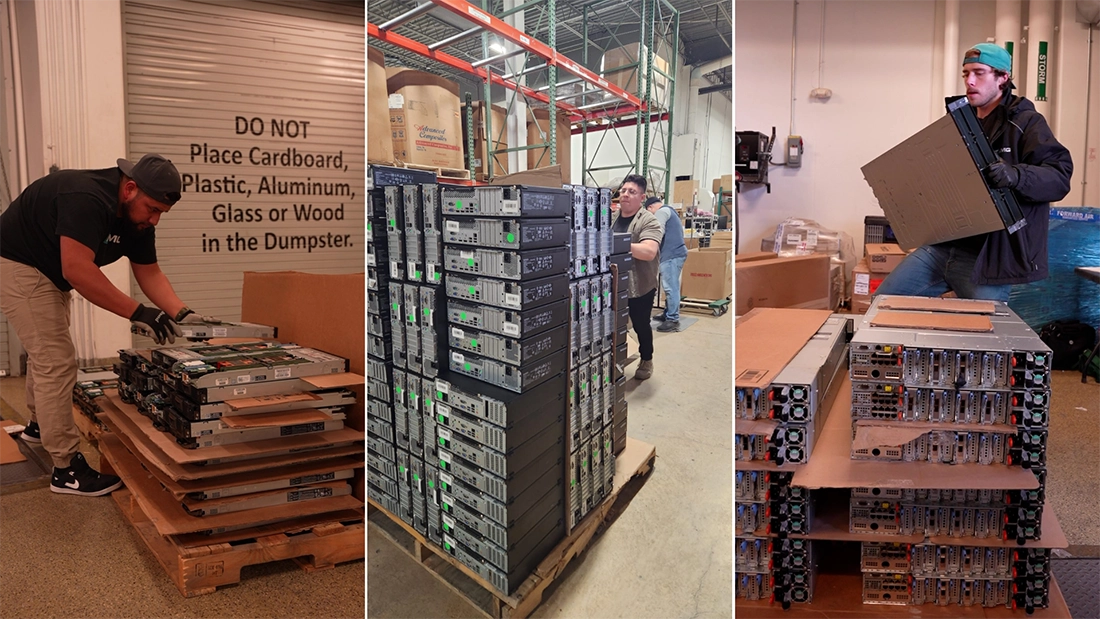
The Three-Checkpoint Custody Framework for Retired IT Assets
A defensible custody trail rests on three checkpoints, intake, transit, and destination, with every step rolling up into a single auditable record. Each checkpoint closes a specific gap where assets, and the proof behind them, tend to go missing.
The table below maps the framework. Read each row as a question: what happens, why it protects you, and what evidence it leaves behind for an auditor.
| Checkpoint | What happens | Why it protects you | Evidence it creates |
|---|---|---|---|
| Intake | Each asset is captured by serial number at the source, witnessed and time-stamped | Establishes exactly what left your control, by serial, not by estimate | Serialized intake manifest |
| Transit | Assets move in sealed, tamper-evident containers under tracked, access-controlled transport | Closes the gap between your dock and the processing facility | Sealed-container log and transport record |
| Destination | Assets are scanned back in and reconciled against the intake manifest before sanitization | Confirms that what left arrived and was accounted for | Reconciliation report |
| Proof | Every checkpoint rolls into the certificate of destruction and a serialized report | Gives auditors one traceable record per asset | Certificate of destruction plus serialized report |
Checkpoint 1: Serialized Intake at the Source
Intake is the foundation, and it has to happen by serial number before anything moves. Recording a pallet as "approximately 40 drives" is not custody. Capturing each drive's serial, witnessed and time-stamped, is.
ITAMG operates a serialized custody process under NAID AAA Certified and R2v3 Certified controls. At collection, ITAMG assumes rights and title to the equipment. The standard onsite shredding process captures each unit's serial number as the anchor of its record. That serial becomes the thread every later checkpoint reconciles against.
Checkpoint 2: Sealed, Tracked Transit
Transit is where custody is most often lost, so assets should travel in sealed, tamper-evident containers under access-controlled, tracked transport. The seal proves the load was not opened. The tracking proves where it went.
Strong programs add controls such as numbered seals and limited handler access so that any tampering shows. ITAMG moves fleet-scale collections under GPS-tracked custody, which keeps the route logged from pickup to the processing facility.
Checkpoint 3: Destination Scan-In and Reconciliation
At the destination, every asset is scanned back in and reconciled against the intake manifest before sanitization begins. The scan confirms that the serials recorded at pickup are the serials that arrived.
Every drive moves through a documented sanitization or destruction process: drives slated for reuse receive certified erasure regardless of any pre-pickup wipe, while drives slated for destruction are physically destroyed. The process is automated, so media does not move through inventory without a documented sanitization or destruction step. Because ITAMG assumes title at collection, a discrepancy such as a condition issue not disclosed at the quote stage is recorded in the audit report rather than treated as a stopping point, and disposition proceeds. When assets leave your control, federal guidance points to Purge as the default outcome, with Destroy when no reuse is planned, logged per asset.
What Audit-Ready Custody Documentation Contains
Audit-ready custody documentation records each asset by serial number, the method used, and the verified result. If a record cannot name the drive and prove what happened to it, it is not audit-ready.
The example below is a generic, illustrative structure, not a real customer record. It shows the fields a serialized destruction report typically carries so each asset is traceable end to end.
| Field | Illustrative entry (generic) | What it proves |
|---|---|---|
| Project / job number | PRJ-00000 | Ties the asset to a specific engagement |
| Service tracking number | SVC-00000 | Links the record to the collection and transport leg |
| Asset / media serial number | Per-device serial, for example WD-XXXXXXXX | Identifies the exact drive, not just a count |
| Source class | Server HDD, laptop SSD, or LTO tape | Records media type and risk level |
| Sanitization method | Purge by erasure, Destroy by shred, or degauss | States how the data was removed |
| Verified result | Passed | Confirms the method achieved sanitization |
| Status | Completed | Shows the asset reached final disposition |
| Disposition | Recycled, remarketed, or returned | Records where the asset went next |
| Completion timestamp | YYYY-MM-DD | Time-stamps the event for the trail |
| Technician / operator | Operator ID | Attributes the action to a named handler |
Strong documentation is rarely a single sheet. For data destruction work, ITAMG produces a layered set: serialized asset reports at the per-item level, a blanket certificate of recycling at the project level, and per-drive erasure reports created each time media is wiped. These layers reinforce each other, which is what a data destruction program built on documented fundamentals is meant to deliver. Federal guidance backs the same point: NIST SP 800-88 Rev. 2, Guidelines for Media Sanitization, calls for verification of the result and documentation through a certificate of sanitization.
How the Custody Trail Produces a Certificate of Destruction
The certificate of destruction is not a standalone document. It is the endpoint of the custody trail, summarizing what the serialized records already prove. A certificate with no underlying per-asset detail is a claim, not evidence.
Think of the relationship as a pyramid. Serialized intake, transit, and reconciliation records sit at the base. The certificate of destruction sits at the top, referencing those records so a reader can trace any single asset back through the chain. Remove the base, and the certificate has nothing to stand on.
Timing depends on where the work happens. ITAMG issues the certificate within one to two business days for onsite destruction. Offsite processing takes roughly 30 to 45 days, running from receipt through settlement and final reporting. If you need the document for a specific audit deadline, confirm format and timing at the quote stage. It also helps to understand how to obtain a data destruction certificate before the project begins.
The certificate is what most auditors ask for first. The custody trail is what they ask for when the certificate alone is not enough.
Serialized Asset Tracking Across the ITAD Lifecycle
Serialized asset tracking is the mechanism that makes the custody trail real. Without per-asset serial numbers, a custody claim is just a count, and a count cannot survive an audit that asks about one specific device.
Serial-level tracking follows each asset through every disposal path, not only destruction. A drive selected for resale still needs proof that its data was sanitized before the chassis re-enters the market. The same serialized record that supports destruction supports remarketing, returns, and recycling, because each path ends with a logged outcome tied to a serial.
The chain does not stop at the processing facility. The R2v3 standard requires that data-bearing devices be tracked and controlled through the downstream chain, and the SERI guidance on qualifying downstream vendors for data devices stresses limiting how many parties ever touch those devices. Custody is only as strong as its weakest handoff. The tracking has to reach everyone who handles the asset, not just the first vendor in the line.
How NAID AAA and R2v3 Reinforce ITAD Custody Controls
Certifications turn custody claims into independently audited facts. NAID AAA and R2v3 both require documented custody controls that third-party auditors verify, so a certified vendor is making a claim that someone outside the company has tested.
NAID AAA Certification, run by i-SIGMA, audits whether strict protocols, including custody controls and employee screening, are followed, using both scheduled and unannounced reviews. The i-SIGMA NAID AAA Certification program ties directly to FACTA, HIPAA, and PCI rules, which is what lets a certified provider support your compliance program.
R2v3 adds the recycling and downstream dimension, governing how data-bearing equipment is secured, sanitized, and tracked to final disposition. ITAMG holds NAID AAA Certified, R2v3 Certified, and RIOS Certified status, is SOC 2 Compliant, and aligns sanitization methods with NIST SP 800-88. For a closer look at what that federal alignment requires, ITAMG documents the NIST SP 800-88 alignment as part of the published credential set. Together, these certifications mean the custody controls described above are not self-graded.
What Breaks a Custody Trail, and How to Prevent It
A custody trail breaks at the handoffs. Any moment an asset changes hands without a recorded, reconciled scan is a moment the chain can quietly fail, and the failure usually surfaces only during an audit.
The common break points are easy to spot. Spotting them is most of the prevention.
- Counting instead of serializing. Logging "two pallets" cannot prove any single drive's fate. Capture serial numbers at intake.
- Unsealed or open transport. Loose totes leave no evidence the load was untouched. Use sealed, tamper-evident containers.
- Commingled loads. Mixing one client's assets with another's destroys traceability. Keep custody segregated by engagement.
- Undocumented downstream handoffs. Losing sight of devices after the first vendor breaks the chain. Track to certified downstream vendors.
- A gap between pickup and processing. Unrecorded dwell time is unaccounted custody. Document every leg, including storage.
Prevention is the inverse of each failure: serialize at the source, seal in transit, reconcile at the destination, and audit the downstream. The Three-Checkpoint framework exists precisely to remove these gaps before they become liabilities.
How to Vet an ITAD Vendor's Custody Controls
Evaluate a vendor's custody controls by asking how they serialize, secure, reconcile, and document every asset, then ask to see a sample, generic record. A vendor with real custody controls can show you the structure of their records without hesitation.
Use the questions below as a screening matrix. The strong answers describe controls an auditor would accept. The red flags describe gaps you would have to explain after a breach.
| What to ask the vendor | Strong answer | Red flag |
|---|---|---|
| How do you record assets at pickup? | Every asset scanned by serial number, witnessed and time-stamped | Assets counted by box or pallet, not serialized |
| How is transport secured? | Sealed, tamper-evident containers in tracked, access-controlled vehicles | Open totes or unsealed loads, no tracking |
| Which certifications do you hold? | NAID AAA Certified and R2v3 Certified, audited by third parties | Self-attested controls with no certification |
| What documentation do I receive? | Serialized asset report, certificate of destruction, and erasure reports | A single certificate with no per-asset detail |
| How is the downstream chain controlled? | Data-bearing devices tracked to certified downstream vendors | No visibility past the first handoff |
These five questions map to the framework: intake, transit, certification, documentation, and downstream. A vendor that answers all five with evidence is offering a defensible custody trail. For a fuller checklist that puts custody in context with pricing, environmental controls, and references, see how to select an IT asset disposition vendor before you sign.
Frequently asked questions
Quick answers to the questions buyers, compliance teams, and IT leaders ask most often about this topic.