
Hard Drive Destruction: Methods, Compliance, and Decisions
Hard drive destruction is the physical process of rendering a storage drive permanently unreadable, typically by shredding, disintegration, or degaussing followed by mechanical destruction. For regulated industries, destruction must align with NIST SP 800-88 sanitization categories, document the chain of custody, and produce a verifiable Certificate of Destruction. This guide breaks down the methods, the compliance framework, the HDD versus SSD decision, and the documentation that should accompany every destruction job.
What is hard drive destruction and why does it matter?
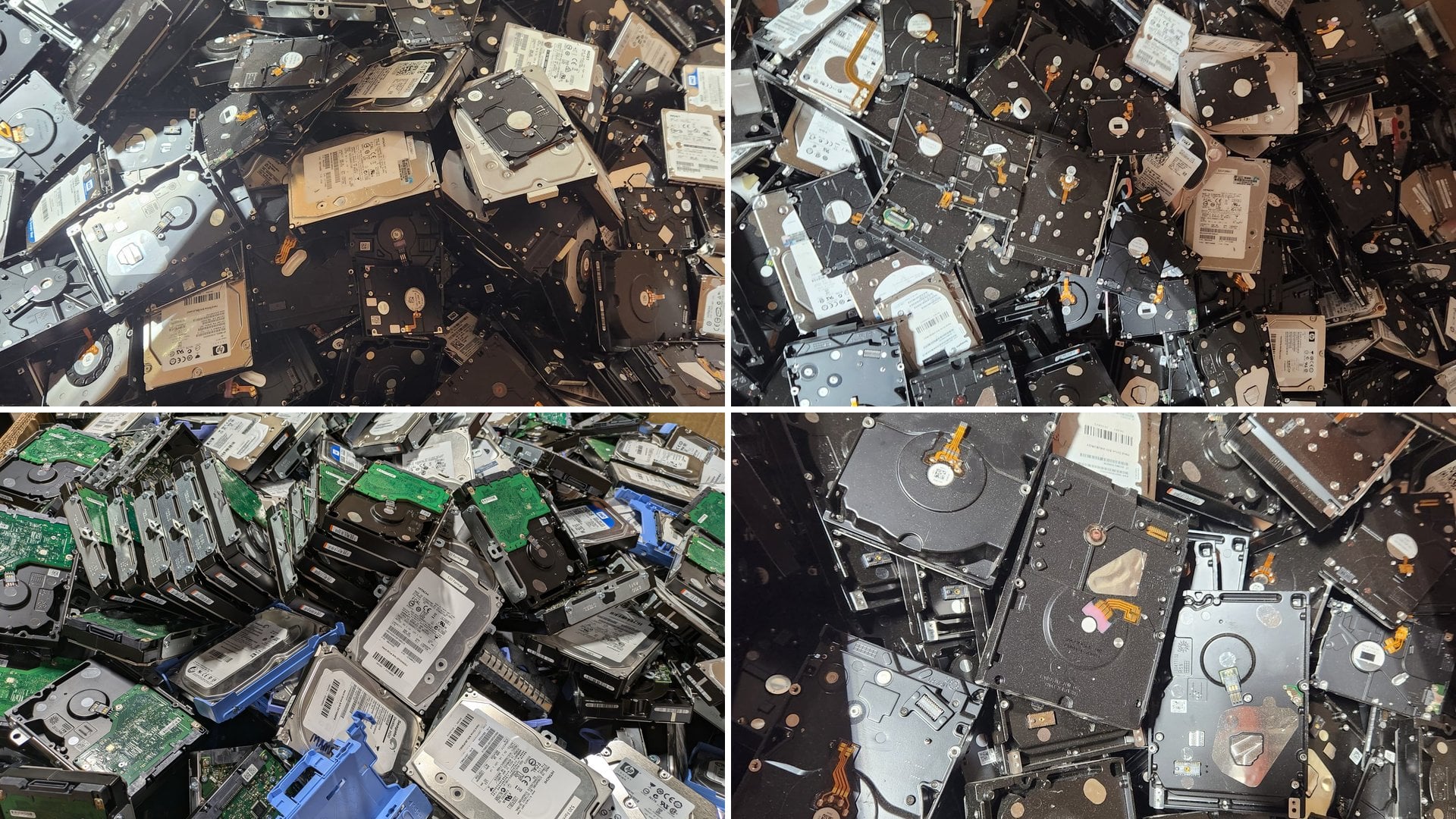
Hard drive destruction permanently destroys a storage drive so the data on it cannot be recovered, typically by mechanical shredding, disintegration, or degaussing followed by shredding. It is the Destroy category in NIST Special Publication 800-88 Rev. 2, distinct from data erasure methods that overwrite or cryptographically wipe the drive while leaving the hardware intact.
The reason it matters: software-based erasure can fail. Drives with bad sectors, controller faults, or hidden partitions may not accept a verified overwrite, and a drive that fails verification cannot be released for resale or reuse without confirming the data is truly gone. Physical destruction closes that gap by removing the question entirely.
Regulated industries treat physical destruction as the safest hard drive disposal path for drives that held protected health information, payment card data, financial records, or classified material. The audit trail is also simpler: a Certificate of Destruction with the drive's serial number is easier to defend than a screen capture of an overwrite log.
How does a certified destruction process work?
A defensible destruction process has five stages: collection, chain of custody, serialization, destruction, and reporting. Each stage produces an artifact that ends up in the audit file.
In ITAMG's experience, a typical hard drive shredding and data destruction services engagement begins with a secure pickup or, when drives must never leave the customer's site, a mobile shredding visit using a plant-grade shredder mounted inside an ITAMG truck. Trucks carry onboard generators, which means the destruction equipment runs without depending on building power.
Before any drive is destroyed, every device is scanned. The drive serial number is captured into the audit record alongside the planned method of destruction; that's the standard for onsite drive shredding. Additional details such as drive capacity, interface, customer asset tags, and barcodes are captured on customer request, so the customer's inventory system can reconcile against the destruction report when that level of detail is required.
Drives are then destroyed. For a witnessed onsite job, the customer or a designee can observe the shredding from start to finish. After destruction, a Certificate of Destruction and Recycling is issued, the audit reports reflect the method used, and any drives that originally entered the data erasure workflow but failed are documented as physically destroyed instead.
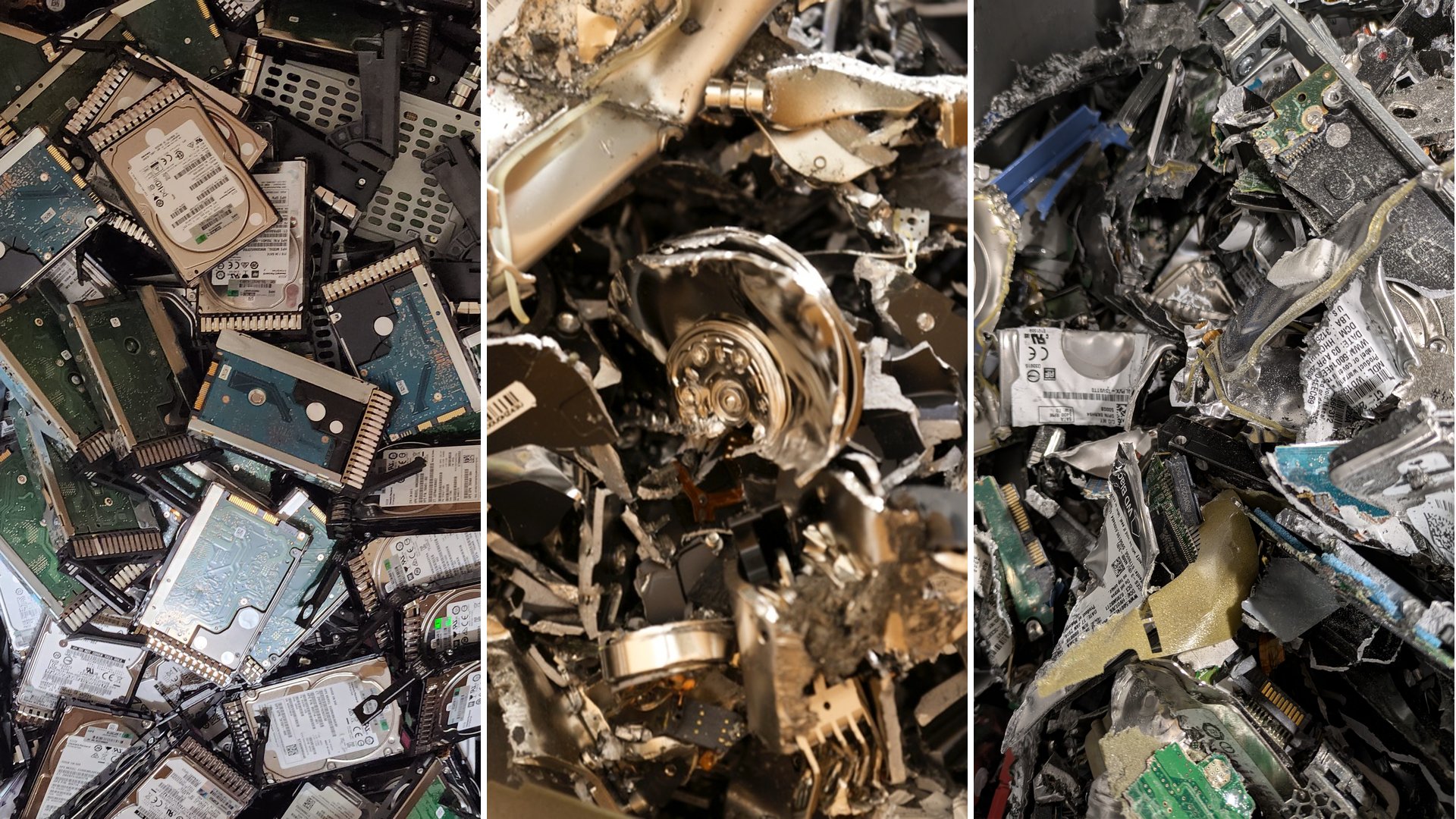
Drive destruction methods: shredding, disintegration, and degaussing
Three destruction methods dominate the enterprise market: shredding, disintegration, and degaussing. They produce different residual particle sizes, fit different media types, and align with different compliance frameworks.
| Method | How it works | Best for | Compliance fit |
|---|---|---|---|
| Shredding | Drive is fed through hardened steel cutters that slice the platters and PCB into strips | HDDs, SSDs, optical media, smartphones | NIST 800-88 Destroy; supports HIPAA and FACTA disposal documentation |
| Disintegration | Drive is repeatedly crushed inside a chamber until particles meet a target millimeter size | Highest-assurance HDD or SSD destruction | Aligns with classified-workflow requirements when matched to the specified machine |
| Degaussing | Strong magnetic field disrupts the magnetic domains on the platter | Magnetic media only (HDDs, tape) | Effective on magnetic media when the degausser is functional; NSA Evaluated Products List listing is required for NSA compliance specifically. No effect on SSDs |
Shredding is the default for most commercial workloads because it handles a mixed-media stream (HDDs, SSDs, USB drives, smartphones) on the same equipment. Disintegration produces a smaller residual particle and is the right answer in two cases: when an organization has chosen a millimeter-grade specification for its destruction policy, or when the lot includes flash media (m.2, mSATA, USB drives) where finer particle output is the safest answer regardless of policy specification.
Degaussing is a media sanitization method that uses a strong magnetic field to disrupt the magnetic domains on a hard drive platter, rendering the data unrecoverable and the drive inoperable. ITAMG operates an NSA Evaluated Products List degausser as part of the mobile destruction workflow on tape and HDD jobs, with the drives typically passing through an industrial shredder afterward to add a physical destruction step on top of magnetic erasure. For solid-state media, degaussing has no effect; the data is stored as electrical charge in flash cells, not as a magnetic pattern.
For the downstream lifecycle of the resulting fragments, see what happens after a hard drive is shredded.
What does NIST 800-88 require for hard drive destruction?
NIST Special Publication 800-88 Rev. 2, finalized in 2025, defines three sanitization categories: Clear, Purge, and Destroy. Clear protects against keyboard-level data recovery. Purge defends against laboratory-grade recovery. Destroy renders the media itself unable to function as storage.
Physical destruction is the Destroy category. Rev. 2 organizes sanitization around an organizational program that validates the chosen method against the storage technology and the risk level rather than mandating a single technique list. The standard is media-agnostic in spirit: a method counts as Destroy if the resulting fragments cannot be reassembled into functional storage.
What NIST 800-88 does not do is prescribe a specific shred size in millimeters. That granularity comes from the National Security Agency's Evaluated Products List, which sets the millimeter targets for classified-environment destruction. Commercial NIST 800-88 compliance does not require a particular particle size; it requires that the destruction method renders the data unrecoverable and is appropriately documented.
For a regulated customer, the practical implication is straightforward. A vendor that destroys drives via shredding or disintegration is performing the Destroy category. A vendor that overwrites drives via certified erasure is performing Clear or Purge. Either path can satisfy compliance, but the documentation must match the method, and the evidence file must include the serials, the method, and the date.
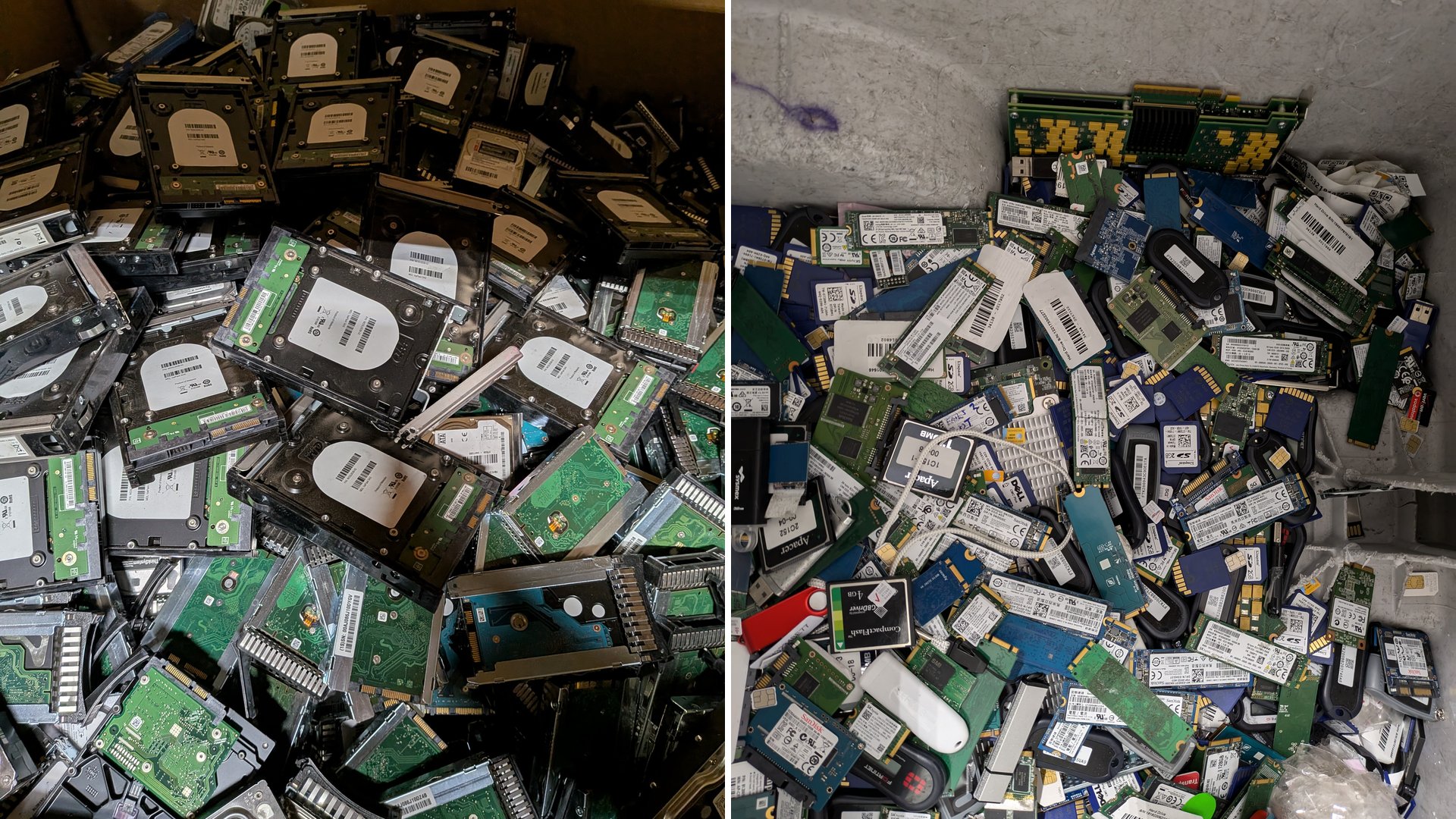
HDD versus SSD: why solid-state media changes the destruction equation
Solid-state drives store data as electrical charge in flash memory cells, not as a magnetic pattern on a spinning platter. That single difference invalidates degaussing as a destruction method for SSDs and changes the calculus on shredding.
The shred-size question matters more for SSDs than for HDDs. SSD data is distributed across multiple flash memory packages, and a single coarse shred can leave individual packages intact if the cut width exceeds the package size. A flash package that survives a shred can sometimes be read in a forensic recovery setting, which is why SSD destruction typically calls for a finer shred than the HDD specification. The defensible answer is to confirm with the destruction provider that the SSD destruction profile compromises the flash packages themselves, not just the drive housing.
ITAMG handles solid-state media inside the same secure destruction workflow used for magnetic drives, with shredding configured for flash media destruction rather than the platter-cutting profile used for HDDs. The drive type is recorded in the destruction audit so the customer's evidence file shows that SSDs were destroyed using a flash-appropriate method.
Mixed lots are common. A retired server typically contains both magnetic boot drives and solid-state cache or storage drives, and a defensible destruction workflow handles each type with the right method, not a single one-size approach. A vendor that markets only HDD shredding without addressing SSD-specific destruction is leaving a meaningful gap in the chain of evidence.
Disposal compliance cross-walk: HIPAA, GLBA, FACTA, and NIST
Most regulated industries do not name a specific destruction technology in their disposal rules. They name an outcome: data is rendered unreadable and the disposal is documented. The cross-walk below maps the dominant U.S. frameworks onto destruction methods.
| Framework | Disposal requirement | What physical destruction provides |
|---|---|---|
| HIPAA Privacy Rule | Reasonable safeguards to prevent impermissible use of PHI on disposed media | Shredding, disintegration, or NIST 800-88 Destroy with serialized audit trail |
| GLBA Safeguards Rule | A safeguards program covering disposal of customer information | Documented destruction with chain of custody contributes to the program's disposal evidence |
| FACTA Disposal Rule | Consumer-report info disposed by burning, pulverizing, shredding, or equivalent | Mechanical destruction methods explicitly listed |
| NIST SP 800-88 Rev. 2 | Choose Clear, Purge, or Destroy based on media and risk; document the method | Destroy category covers shredding and disintegration with audit reporting |
Notably, HIPAA does not mandate physical destruction of all drives that carried protected health information. The Privacy Rule requires reasonable safeguards to prevent impermissible use of PHI on disposed media; verified data erasure with documented chain of custody can also satisfy that bar. Physical destruction is one defensible secure hard drive disposal path among several, chosen most often for drives that failed erasure or where the organization's policy requires it.
A defensible disposal program does not pick one framework; it documents how a single destruction event satisfies the relevant frameworks for the data the drive contained. ITAMG holds R2v3, NAID AAA, and RIOS certifications, which together address responsible recycling, secure data destruction, and integrated environmental management. ITAMG operates as NIST SP 800-88 compliant and SOC 2 compliant; neither is held as a standalone certification.
That stack helps the certificate and audit report map the destruction event to the standards most compliance teams expect to see.
For vendor-screening criteria before signing, see how to choose a data destruction provider.
Onsite versus offsite drive shredding: which option fits your workflow?
Onsite hard drive destruction means the drives are destroyed at the customer's facility, typically by a mobile shredding truck. Offsite means the drives are collected, transported under chain of custody, and destroyed at the vendor's processing plant. Both can satisfy NIST 800-88 and the HIPAA law for disposal of health information. The choice is usually operational, though specific contracts, internal policies, or classified workflows may require onsite destruction.
Onsite is the right choice when the customer's policy says drives must never leave the building intact, when the destruction needs to be witnessed live, or when the transportation custody window between collection and destruction must be reduced to zero. The customer or a designee can stand at the truck and watch every drive enter the shredder.
Onsite shredding keeps the drives inside the customer's facility until they are physically destroyed. Offsite adds a controlled chain-of-custody step and a documented transportation segment.
Offsite is the right choice when the customer wants to keep costs lean or when a faster pickup window is preferred over a longer onsite event. Volume alone is not the trigger; ITAMG runs plant-grade shredders onsite via mobile equipment, and per-drive pricing typically improves as volume grows, so large projects are often more cost-efficient than buyers expect. ITAMG's standard offsite destruction service includes a documented chain of custody, secure transportation, plant-grade shredding, and a Certificate of Destruction issued to the customer.
In ITAMG's experience, healthcare and financial-services customers often default to onsite destruction for regulated lots and use offsite destruction for non-regulated decommissioning. Pairing the two on a single engagement is common: one onsite event for the most sensitive drives and a scheduled pickup for the bulk inventory. ITAMG's onsite turnaround is typically one to two business days from scheduling; offsite turnaround for documentation runs longer.
| Requirement | Choose onsite | Choose offsite | Audit note |
|---|---|---|---|
| Drives must never leave the building intact | Yes | No | Onsite mobile shredder eliminates intact-drive transit |
| Witnessed destruction is required | Yes | Optional | Customer or designee observes shredder feed |
| Mixed-media destruction (HDDs, SSDs, tape) | Yes | Yes | Confirm method profile matches every media type |
| Tightest documentation turnaround | Yes | Slower | Onsite finishes paperwork same day |
| Customer wants to keep costs lean | Possible at volume | Yes | Per-drive pricing improves with volume on either path; offsite plant overhead is the typical cost-lean default for smaller jobs |
| Faster pickup window preferred over longer onsite event | No | Yes | Offsite collection scheduled to a single pickup; destruction batched at the plant |
Certificate of Destruction: what auditable documentation looks like
A Certificate of Destruction is the audit artifact that closes the loop on a drive's lifecycle. Without one, an organization cannot prove the drive was sanitized, and an auditor will treat the disposal as unverified. The certificate should be issued at the conclusion of every destruction event, whether onsite or offsite.
A defensible Certificate of Destruction names the certifying entity, lists the drives by serial number, identifies the destruction method, includes the date and location of destruction, references the standards under which the destruction was performed, and is signed by an authorized representative of the destruction provider. The certificate should match the drive list captured at intake; any discrepancies are addressed in a supplemental report.
A representative Certificate of Destruction includes the following fields:
| Field | What appears on the certificate |
|---|---|
| Certifying organization | Name and address of the destruction provider |
| Standards referenced | NIST SP 800-88, NAID AAA, R2v3, and any other applicable framework |
| Destruction method | Plant shredding, mobile shredding, disintegration, or degaussing followed by shredding |
| Date of destruction | Exact date the destruction event occurred |
| Location of destruction | Customer facility (onsite) or destruction provider's processing plant |
| Drive serial numbers | Serial captured at intake for every drive included in the destruction lot |
| Authorized signature | Destruction provider's representative; witness signature where the customer designee observed |
ITAMG issues a combined Certificate of Destruction and Recycling that documents both the data destruction event and the downstream disposition of the resulting material. The certificate is paired with an audit report that captures drive serials, the method of erasure or destruction, and the success or failure of any erasure step that preceded destruction. When requested or applicable, the audit report also captures additional hardware details such as capacity, processor, RAM, customer asset tags, and barcodes.
For organizations consolidating multiple destruction events into an annual compliance package, the certificate is the document that ties the disposal back to the original asset record.
For common certificate questions before scheduling a job, see the secure data destruction certificate guidance.
How to choose a hard drive destruction provider
When evaluating hard drive shredding services, start with the certification stack, then verify method fit, chain-of-custody controls, SSD handling, and certificate detail. A vendor that holds NAID AAA for data destruction, R2v3 for responsible recycling, and an integrated management system certification (such as RIOS) has been audited against documented standards by an accredited third party. A vendor that lists certifications without naming the standards body has not been audited the same way.
One specific watch-out under R2v3: not all R2v3 certifications are equivalent the way they were under earlier versions. The standard's data-sanitization scope is now split, and customers handling regulated data should confirm the vendor is certified to both parts of Appendix B. That's the buyer signal that the vendor's data-sanitization process is fully audited under the current R2v3 framework.
Ask for the destruction method, in detail. A serious hard drive shredding service will name the equipment class (plant-based shredder, mobile shredder, disintegrator), explain how the method handles HDDs versus SSDs, and walk through the chain-of-custody steps. A vague answer should trigger additional diligence before vendor selection.
Ask for a sample Certificate of Destruction before scheduling. The certificate should list serials, methods, dates, and certifications, and it should be signed.
The fastest way to scope a quote accurately is to share the count, mix of media types, location, and any compliance frameworks that apply. For quote inputs, see the hard drive shredding quote checklist.
ITAMG documents onsite and offsite destruction workflows that both produce a Certificate of Destruction, with regional onsite coverage across major U.S. metros.
For a city-specific example, see hard drive shredding and data destruction in Atlanta.
ITAMG delivers onsite and offsite hard drive destruction service with one-to-two-business-day onsite turnaround from scheduling, plant-grade mobile shredding, and a Certificate of Destruction issued under R2v3, NAID AAA, and RIOS certifications.
Frequently asked questions
Quick answers to the questions buyers, compliance teams, and IT leaders ask most often about this topic.